
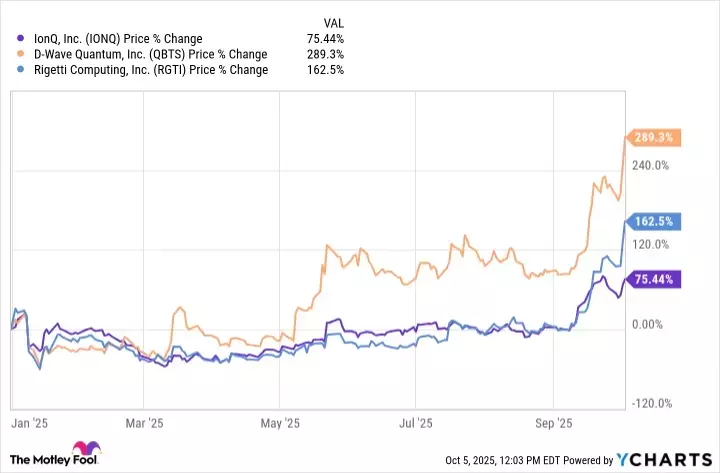
The quantum computing market has witnessed an astonishing surge in stock values during 2025, sparking intense debate about whether these sky-high valuations truly reflect groundbreaking advancements or are merely fueled by speculative fervor. While the underlying technology holds immense promise for transforming various sectors, the financial performance of leading companies in this space presents a complex picture.
Quantum Computing Stocks: A Closer Look at Market Dynamics and Company Performance
In the vibrant fall of October 2025, the quantum computing sector finds itself under the spotlight, with several key players experiencing unprecedented stock rallies. George Budwell's report from October 6, 2025, sheds light on the spectacular gains of companies such as IonQ, D-Wave Quantum, and Rigetti Computing. IonQ, for instance, has seen a 75% increase since January, D-Wave Quantum an astounding 289%, and Rigetti Computing a significant 162% rise.
These surges are underpinned by substantial developments. China recently achieved a 12,900-kilometer quantum satellite link, signaling a new era in secure communication. Concurrently, the Defense Advanced Research Projects Agency (DARPA) has committed $1 billion towards achieving utility-scale quantum computing by 2033. The United States government is also actively pursuing quantum-resistant encryption solutions, anticipating a 'Q-Day' when quantum computers could potentially compromise existing security protocols. Such governmental and institutional interest has channeled considerable capital into the sector, lending credence to the idea that these companies, despite their current valuations, might be wise investments, especially given McKinsey's projection of an $850 billion market by 2040.
However, the financial realities for these companies are striking. IonQ, despite its innovative room-temperature trapped-ion systems and strategic alliances with AstraZeneca and Amazon Web Services, trades at over 300 times its trailing sales. Its projected revenue of $100 million for 2025 and an anticipated profitability not before 2030 underscore a significant valuation challenge. Similarly, D-Wave Quantum, with its focus on quantum annealing for optimization tasks and a reported $819 million in cash reserves post-July's $400 million capital raise, is valued at over 300 times its trailing sales, with analysts forecasting only $70 million to $75 million in annual revenue by 2027. Rigetti Computing, a leader in quantum hardware fidelity and recipient of a $35 million investment from Quanta Computer, faces an even steeper challenge, trading at over 1,100 times sales. Its latest quarterly report showed a 42% year-over-year revenue decline to $1.8 million, alongside a net loss of $40 million, although its $572 million cash reserves provide some operational latitude.
These figures highlight a considerable disparity between the technological promise and the current financial performance. While each company showcases unique strengths and contributes to the quantum computing paradigm shift, their valuations suggest a market anticipating perfection and rapid commercialization that is yet to materialize. The journey to widespread profitability in this nascent industry remains long and resource-intensive.
The quantum computing market stands at a critical juncture, balancing immense potential with significant financial risks. While the transformative power of this technology is undeniable, current valuations appear to outpace immediate commercial viability. Investors must carefully assess the speculative nature of these high-growth stocks, understanding that despite their revolutionary promise, the path to sustained profitability is fraught with challenges, particularly when competing against tech giants with vast resources. For those with a high-risk tolerance, a modest allocation might be considered; however, value-oriented investors may find more suitable opportunities elsewhere, as the market currently prices in an almost flawless execution for companies still years away from consistent earnings.
