
In the dynamic realm of artificial intelligence, two prominent technology companies, D-Wave Quantum and Nvidia, are pursuing distinct paths to push the boundaries of AI capabilities. D-Wave Quantum is pioneering the application of annealing quantum computers, designed for rapid and complex calculations, and has introduced an AI toolkit for software developers. Nvidia, a leader in conventional AI, is leveraging its groundbreaking Blackwell superchip architecture to enhance existing AI systems and facilitate a future integration with quantum technologies. This report delves into their strategies, financial health, and market performance to provide a comprehensive comparison for investors.
The Intersection of AI and Quantum Computing: D-Wave Quantum vs. Nvidia
Artificial intelligence, a field experiencing rapid advancements, is poised for a significant leap with the integration of quantum computing. This emerging technology harnesses quantum mechanics to achieve computational power far beyond the scope of traditional supercomputers. Within this exciting landscape, two companies, D-Wave Quantum and Nvidia, are carving out unique positions. Robert Izquierdo's analysis, published on September 26, 2025, illuminates their differing strategies and market standing.
D-Wave Quantum is at the forefront of developing annealing quantum computers. These specialized machines are adept at identifying optimal solutions from a vast array of possibilities, demonstrating their prowess by solving intricate calculations in minutes that would take classical supercomputers millennia. The company's release of an AI toolkit this year, enabling software developers to interface with its quantum systems via frameworks like PyTorch, marks a pivotal moment in quantum AI development. This innovation promises to mitigate the escalating costs associated with building AI models and leverage the superior computational capabilities of quantum computers. Research institutions globally, including those in Germany, Canada, and Japan, have already reported significant AI enhancements using D-Wave's technology. Financially, D-Wave Quantum reported a 42% year-over-year increase in second-quarter revenue, reaching $3.1 million. However, operating expenses surged by 41% to $28.5 million, resulting in an operating loss of $26.5 million for the quarter.
Conversely, Nvidia has been a driving force behind the current surge in generative AI applications, epitomized by platforms like OpenAI's ChatGPT. The company's latest technological marvel, the Blackwell superchip, is redefining the limits of classical computing. Blackwell integrates multiple semiconductor chips into a single, massive computer processor, designed to support the most complex AI models. Nvidia envisions Blackwell serving as a crucial bridge between classical and quantum computing, allowing users to develop quantum software applications without direct access to quantum hardware. This strategy aims to overcome current limitations of quantum devices, such as calculation errors, paving the way for a symbiotic relationship between the two computing paradigms. Blackwell production commenced in late 2024 and has quickly gained traction, contributing to a 17% sequential increase in sales during Nvidia's fiscal Q2. The company's overall revenue climbed 56% year-over-year to $46.7 billion, yielding an impressive operating income of $28.4 billion.
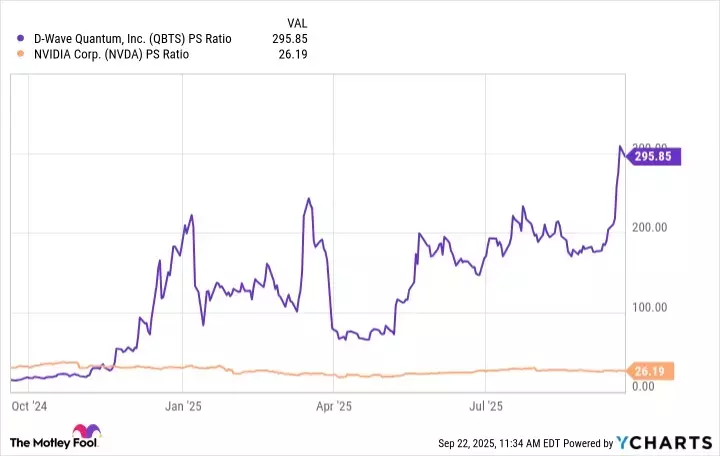
When evaluating these two entities for investment, their market performance and valuation metrics offer further insight. While D-Wave's stock has seen a remarkable surge of over 200% in 2025, buoyed by favorable interest rate cuts, Nvidia has also delivered a robust gain exceeding 30%. However, a critical distinction lies in their profitability and valuation. As D-Wave Quantum is not yet profitable, its valuation is best assessed using the price-to-sales (P/S) ratio. Current data indicates that D-Wave's P/S ratio is significantly higher than Nvidia's, suggesting a considerably more expensive stock by comparison. Despite the exciting potential of quantum computing, it remains an nascent field with considerable challenges. D-Wave's increasing operating losses relative to its modest revenue present a long-term financial concern. Nvidia, with its profitable and expanding business, a measured strategy for quantum transition, and more attractive stock valuation, emerges as the more compelling AI investment. Furthermore, Nvidia's recent multi-billion dollar investments in industry giants like Intel and OpenAI underscore its commitment to strengthening its AI infrastructure and offerings, solidifying its position as a leading long-term investment in the AI sector.
This comparison highlights the diverse approaches companies are taking to harness the power of artificial intelligence. While D-Wave Quantum represents the bleeding edge of quantum AI, its nascent stage and financial challenges present higher risks. Nvidia, with its strong foundational technology, robust financial performance, and strategic vision for integrating classical and quantum computing, appears to offer a more stable and promising investment trajectory in the rapidly evolving AI landscape. Investors should carefully consider these factors, recognizing the immense potential and inherent uncertainties of both traditional and quantum AI advancements.
