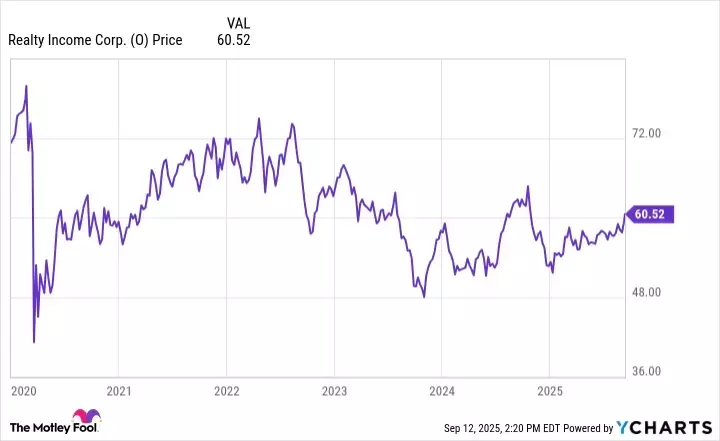

Realty Income, known as \"The Monthly Dividend Company,\" presents a robust investment opportunity driven by its stable business model, consistent dividend growth, and an undervalued stock price poised for appreciation as interest rates decline. This analysis delves into the core strengths that make it a noteworthy contender for investors seeking long-term value and income.
Unlock Growth and Income: Why Realty Income is Your Next Smart Move
Understanding Realty Income's Strategic Business Model
Realty Income Corporation operates as a real estate investment trust, specializing in the ownership and leasing of single-tenant commercial properties. Its distinctive business strategy involves net-lease agreements, where tenants assume responsibility for property-related expenses such as maintenance, insurance, and taxes. This structure ensures a predictable and stable income stream for Realty Income. The company's portfolio boasts approximately 15,600 properties, maintaining an impressive occupancy rate of nearly 99%. These properties are leased to well-established national and international enterprises, further solidifying its revenue base. This robust foundation provides investors with compelling reasons to consider its stock before broader market recognition drives up its price.
The Power of Consistent Dividends
As a REIT, Realty Income is legally mandated to distribute a significant portion of its taxable income, specifically at least 90%, to shareholders as dividends. While this is a general requirement for REITs, Realty Income distinguishes itself with its commitment to monthly payouts, a feature that has earned it the moniker \"The Monthly Dividend Company.\" Since its public debut in 1994, the company has consistently increased its dividend payments annually. Currently, the annual dividend payout is approximately $3.23 per share, translating to a dividend yield of 5.3%. This yield is notably higher than the S&P 500's average of 1.2%. Furthermore, the company's funds from operations (FFO) income, a key metric for REITs reflecting cash flow, stands at $4.11 per share, comfortably covering its dividend obligations and indicating the sustainability of future payout increases.
Unveiling the True Valuation of Realty Income
Often, high dividend yields are associated with lower stock valuations. However, assessing a REIT's valuation requires careful consideration. Traditional price-to-earnings (P/E) ratios can be misleading for REITs because interest expenses, which are tax-deductible, can significantly reduce reported net income. For instance, Realty Income's P/E ratio of 58 might appear steep, especially when compared to its five-year average of 54. Yet, this perspective overlooks the more relevant metric for REITs: funds from operations (FFO). When evaluated using the price-to-FFO ratio, Realty Income's valuation drops to a more attractive 15. This suggests that what might initially seem like an expensive stock is, in fact, reasonably priced, presenting a valuable opportunity for informed investors.
The Impact of Declining Interest Rates
A crucial factor set to significantly benefit Realty Income is the anticipated shift in the interest rate environment. Historically, rising interest rates lead to increased interest expenses, which can suppress a company's profits and FFO income. This dynamic is partly why Realty Income's stock currently trades more than 25% below its 2020 peak. However, with the Federal Reserve's projected interest rate cuts, the landscape is poised to change. The Fed has several meetings scheduled through 2025, with expectations for steady rate reductions. This change presents a dual advantage for Realty Income. Firstly, lower rates could enable the company to refinance existing debt at more favorable terms, thereby reducing interest expenses. Secondly, a more accessible credit market could facilitate an increase in strategic acquisitions and property developments. Given the existing high occupancy rate, these expansions are likely to boost revenue and, consequently, FFO income over time. These combined effects are expected to contribute to a higher stock price and enhanced dividend income for shareholders.
A Strategic Investment in a Stable Real Estate Giant
In essence, Realty Income offers a compelling investment thesis built on a foundation of operational stability, a geographically diversified portfolio of single-tenant, net-leased properties, and a remarkable occupancy rate. Investors can currently capitalize on an attractive dividend yield that is well-supported by robust FFO income. The company's valuation, when properly assessed through the price-to-FFO ratio, reveals a stock that is more affordable than it initially appears. The impending decline in interest rates, driven by the Federal Reserve's policy shifts, is expected to act as a significant catalyst. This will not only lead to reduced borrowing costs but also create opportunities for strategic growth through new acquisitions and developments. These factors combined are set to drive both an increase in FFO income and a higher stock price, making Realty Income an appealing choice for those seeking a blend of income and capital appreciatio
