
Once seen as a reliable barometer of the broader U.S. stock market, the S&P 500 index has recently become disproportionately influenced by a handful of technology giants. This shift has prompted a reevaluation of long-held investment philosophies, including the widely cited advice from figures like Warren Buffett to simply invest in an S&P 500 index fund. While historically sound, this strategy may now expose investors to unexpected levels of concentration risk. Understanding this evolving landscape and exploring alternatives, such as equally weighted exchange-traded funds, is crucial for those seeking a more balanced and representative market exposure.
For decades, legendary investor Warren Buffett has advocated for the average individual to invest in S&P 500 index funds, hailing it as a straightforward path to long-term wealth accumulation. His own company, Berkshire Hathaway, with its substantial market capitalization, stands as a testament to strategic, long-term investing. Buffett's wisdom typically emphasizes simplicity and broad market exposure. However, the current composition of the S&P 500 presents a unique challenge to this advice. The index, which is weighted by market capitalization, now sees a significant portion of its value concentrated in a few dominant technology companies, largely driven by the recent surge in artificial intelligence and related sectors.
This tech-heavy tilt means that a standard S&P 500 index fund is no longer as diversified as it once was. Companies like Nvidia, Microsoft, and Apple collectively command a substantial percentage of the index's total weight, far exceeding their historical impact. This concentration makes the index's performance highly susceptible to the fortunes of these specific companies and the broader technology sector. While this has benefited investors during periods of tech sector growth, it introduces a heightened risk if these companies or the sector experience a downturn. Such a scenario could lead to a less accurate reflection of the overall U.S. economy, diverging from the index's original intent as a comprehensive market benchmark.
The historical purpose of the S&P 500 was to offer a broad, transparent representation of the U.S. stock market's performance, encompassing various sectors that mirrored economic trends. However, with technology stocks now making up an unprecedented share—around 34% of the entire index, and nine out of its top ten holdings being tech-related—the index's ability to provide a truly diversified picture of the national economy is diminished. This level of concentration is even greater than during the peak of the dot-com bubble, prompting investors to consider whether a standard S&P 500 fund still aligns with their diversification goals.
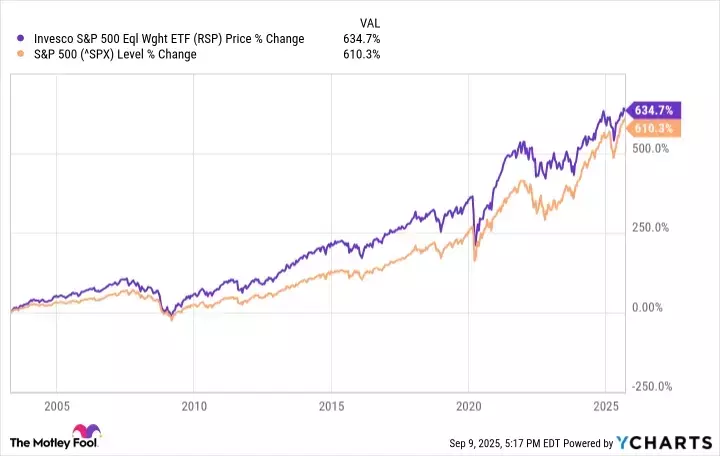
To counteract this increased concentration in the S&P 500, investors have several options. One approach involves supplementing a core S&P 500 ETF holding with sector-specific ETFs to gain exposure to underrepresented areas like materials, real estate, utilities, and energy, which together currently account for only about 9% of the index. A more direct alternative is to invest in an equal-weight S&P 500 ETF, such as the Invesco S&P 500 Equal Weight ETF (RSP). This type of fund allocates roughly equal amounts of capital to each company in the S&P 500, regardless of market capitalization, thus significantly reducing the influence of megacap tech stocks. The Invesco S&P 500 Equal Weight ETF has demonstrated a track record of outperforming the traditional market-cap-weighted S&P 500 since its inception in April 2003, with the tech sector representing a more balanced 13.9% of its portfolio. This strategy allows investors to maintain exposure to the S&P 500 companies while mitigating the risks associated with an over-reliance on a few dominant technology firms.
In conclusion, while the S&P 500 remains a cornerstone of many investment portfolios, its recent technological dominance necessitates a more nuanced approach for today's investors. The shift toward heavy concentration in tech giants challenges the traditional understanding of market diversification provided by the index. Therefore, adopting strategies such as investing in equal-weight S&P 500 ETFs or diversifying with sector-specific funds can offer a more robust and balanced exposure to the broader market, ensuring that investment portfolios are resilient to sector-specific fluctuations and more accurately reflect the diversity of the U.S. economy.
