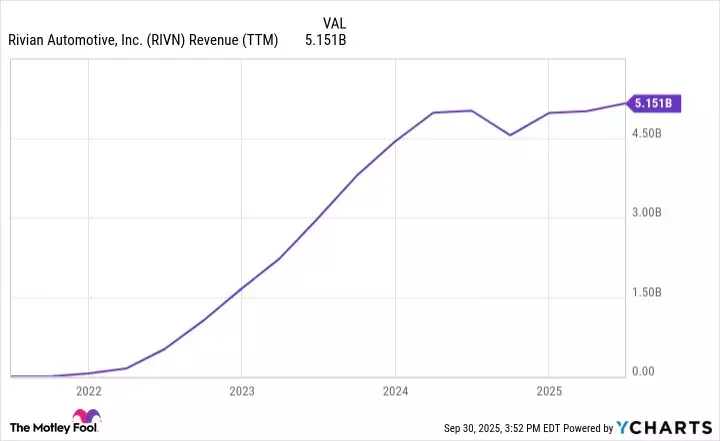

Rivian, an electric vehicle pioneer, is navigating a complex landscape marked by both promising long-term growth strategies and immediate operational hurdles. Despite a recent slowdown in vehicle deliveries, the company is making a substantial commitment to its future through significant factory expansion initiatives. This strategic move aims to broaden its market reach by introducing more accessible, lower-priced models, thereby addressing the current challenge of high-cost R1 vehicles. However, the path to sustained profitability remains uncertain, with its current valuation reflecting investor caution about the successful execution of these ambitious plans.
Electric vehicle stocks have experienced a volatile period, characterized by rapid growth followed by market corrections. Rivian Automotive, like many in the sector, saw its stock price decline significantly after an initial boom. Despite this, the company, backed by major investors, is pushing forward with a clear vision for long-term expansion. While un profitable today, Rivian's commitment to scaling its manufacturing operations is a critical step towards achieving financial viability.
Rivian introduced its R1 models, an electric SUV and truck, in 2022, alongside commercial delivery vans for clients such as Amazon. Although customers have lauded the R1 models, their premium pricing, starting at $75,000 or more, has limited widespread adoption. Consequently, Rivian's quarterly deliveries have seen a decline since peaking in 2023, with current figures just exceeding 10,000 units. This relatively small production volume in the vast automotive market has contributed to the company's ongoing unprofitability.
To overcome these challenges, Rivian is actively expanding its Illinois factory and has initiated construction on a new facility in Georgia. These new plants are crucial for the production of its upcoming R2 and R3 models, which are designed to be more affordable and appeal to a broader consumer base. Achieving economies of scale is vital for automotive manufacturers to become profitable, as demonstrated by companies like Tesla, which only reached profitability after significantly increasing its quarterly vehicle deliveries. Rivian anticipates a similar trajectory to ensure consistent shareholder returns.
Rivian's current market capitalization stands at approximately $17.7 billion, a figure considerably lower than its initial public offering highs. Traditional valuation methods based on trailing earnings or cash flow are not applicable due to the company's negative financial performance. However, a forward-looking assessment can project potential revenue and profits if the R2 and R3 vehicle production successfully scales up. Should Rivian achieve quarterly deliveries exceeding 50,000 units, its annual revenue could reach an estimated $20 billion. Given the typical profit margins in the automotive industry, which range from 0% to 10%, this could translate into $1 billion in net earnings by the decade's end.
While the prospect of Rivian doubling its stock price by 2030, should its factory expansion plans prove successful, is enticing, it also carries substantial risk. The company's history of financial losses, narrow gross margins, and considerable cash burn since its inception underscore the speculative nature of this investment. Despite the potential for a turnaround with its new models, the inherent risks may deter many investors, suggesting that the current opportunities do not outweigh the significant uncertainties involved.
