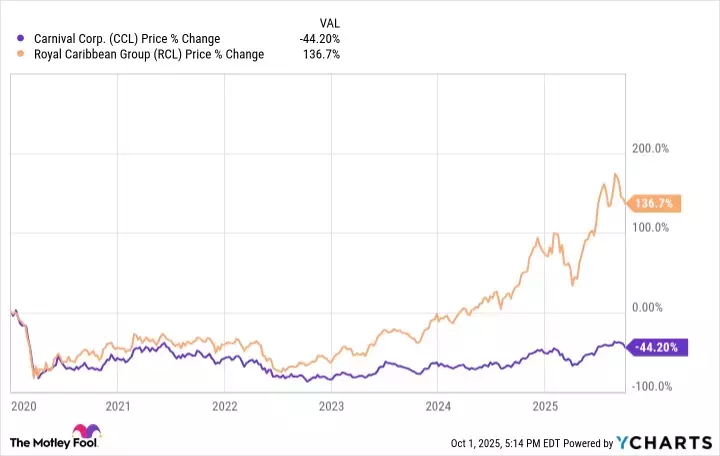

In the competitive landscape of the cruise industry, two major entities, Carnival and Royal Caribbean, stand out as market leaders. Post-pandemic, both companies have demonstrated significant resilience, evidenced by high occupancy rates and a concerted effort to mitigate their substantial debt burdens. While Carnival maintains the largest market share, a detailed examination of financial indicators suggests that Royal Caribbean might currently offer a more compelling investment opportunity, particularly due to its robust financial health and shareholder-friendly policies.
The current market conditions reflect a strong demand for cruise travel, with both Carnival and Royal Caribbean experiencing bookings that often exceed their operational capacities. This surge has prompted both companies to expand their fleets, though challenges remain in accelerating this expansion due to the capital-intensive nature of shipbuilding and the ongoing process of debt management. Royal Caribbean's strategic financial moves, such as its dividend reinstatement and a more favorable debt-to-equity ratio, highlight its strong recovery trajectory and its potential to deliver superior long-term returns for investors.
Dominance and Recovery in the Cruise Sector
Carnival and Royal Caribbean, recognized as the premier operators in the global cruise sector, have navigated significant financial challenges, particularly the severe disruptions caused by the recent global health crisis. Despite incurring substantial losses and accumulating considerable debt during this period, both organizations have successfully initiated a remarkable recovery. They have consistently filled their vessels, often surpassing pre-pandemic capacity levels, which is a testament to the resilient demand for cruise holidays. This operational success has enabled them to begin systematically reducing their outstanding debt, improving their financial stability and setting the stage for future growth.
However, a closer look at their respective financial health reveals subtle differences. While Carnival holds the larger share of the passenger market, Royal Caribbean has demonstrated superior performance in certain key financial metrics. Its ability to manage debt more effectively, as indicated by a lower debt-to-equity ratio, showcases a stronger balance sheet. Furthermore, Royal Caribbean's decision to reintroduce and subsequently increase its dividend payments signals robust financial confidence and a commitment to rewarding shareholders, a move that distinguishes it from Carnival, which has yet to resume its dividend. These factors suggest that Royal Caribbean is not only recovering but is also positioning itself as a potentially more attractive investment in the long run.
Comparative Financial Health and Investment Potential
An in-depth analysis of the financial standing of Carnival and Royal Caribbean reveals key distinctions that could influence investor decisions. Although both cruise lines are actively working to pay down the significant debts accumulated during the pandemic, their approaches and outcomes vary. Royal Caribbean has shown a more aggressive and successful deleveraging strategy, resulting in a more favorable debt-to-equity ratio compared to Carnival. This healthier balance sheet gives Royal Caribbean greater flexibility and reduces its financial risk, making it a more secure investment option in the eyes of many analysts and investors.
The financial confidence exhibited by Royal Caribbean is further underscored by its reinstatement of dividend payments in 2024, a clear signal of its stable cash flow and positive outlook. This contrasts with Carnival, which has not yet resumed its dividends. While Carnival's stock may present an opportunity for short-term gains due to its lower price-to-earnings (P/E) ratio and its market leadership, Royal Caribbean's superior financial metrics, including its capacity to generate consistent shareholder returns through dividends, suggest a more sustainable and potentially higher-growth investment trajectory. The market's perception of Royal Caribbean as a more reliable and financially sound company is reflected in its higher P/E ratio, indicating a willingness by investors to pay a premium for its demonstrated financial strength and future prospects.
