
Despite a historical tendency for September to be a challenging month for the stock market, the S&P 500 has demonstrated unexpected resilience, recording a notable gain this month. This defiance of past patterns is attributed to robust corporate news, especially from leading technology firms, and a prevailing optimism regarding potential adjustments to interest rates by the Federal Reserve. While current market valuations appear elevated, suggesting that finding undervalued assets might be difficult, a long-term investment perspective remains crucial. Investors are encouraged to look beyond immediate market swings and concentrate on the intrinsic value, financial health, and future growth prospects of individual companies.
S&P 500's September Performance: A Detailed Report
Traditionally, September has been a period of apprehension for investors, as historical data, particularly over the last 75 years, reveals an average decline of 0.7% for the S&P 500 during this month. Recent years have largely mirrored this trend, with the index falling in four out of the last five Septembers. However, September 2025 has unfolded differently, with the S&P 500 climbing 1.9% as of mid-month. This unexpected surge is primarily driven by two key factors: strong corporate earnings and the anticipation of economic policy changes.
Several significant corporate announcements have buoyed market sentiment. Tech giants like Broadcom and Oracle reported impressive growth in their artificial intelligence (AI) divisions. On September 4th, Broadcom announced a 63% increase in AI revenue, reaching $5.2 billion, with projections to hit $6.2 billion next quarter. Similarly, Oracle captivated investors with forecasts for its cloud infrastructure revenue, largely powered by AI customers. The company reported a 55% rise to $3.3 billion in its latest quarter, expecting a 77% increase to $18 billion for the fiscal year, and an ambitious target of $144 billion within four years. These positive developments follow Nvidia's earlier prediction that AI infrastructure spending could reach $4 trillion by the decade's end, collectively intensifying interest and investment in technology stocks, which hold substantial weight in the S&P 500.
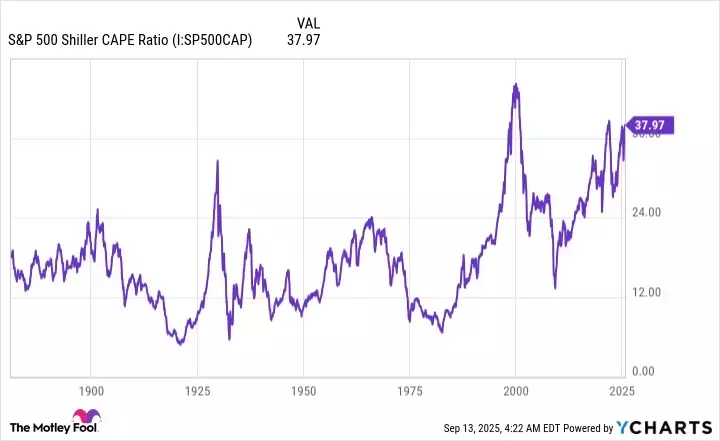
Despite this positive momentum, the market currently presents high valuations. The S&P 500 Shiller CAPE ratio, an inflation-adjusted measure of stock prices relative to earnings, stands at 37. This level has been surpassed only twice before, indicating that finding undervalued stocks may be challenging in the current climate. Looking ahead, investors are closely watching the Federal Reserve's upcoming decision on interest rates, scheduled for Wednesday. Economists anticipate a rate cut, a move that could further stimulate the market by reducing borrowing costs for both consumers and businesses.
Investment Philosophy in a Dynamic Market
In a market characterized by historical anomalies and high valuations, investors might find themselves at a crossroads. The S&P 500's unusual September performance and elevated CAPE ratio present a complex picture. However, the core principle of investing remains steadfast: adopt a long-term perspective. Instead of being swayed by short-term market fluctuations or general valuation concerns, investors should meticulously evaluate individual stocks. Focusing on a company's financial health, its long-term growth prospects, and whether its valuation is reasonable are paramount. History shows that the S&P 500 has consistently recovered from downturns, achieving an average annual gain of 10% since its inception. By adhering to a long-term strategy and thorough individual stock analysis, investors can navigate any market environment with confidence and peace of mind.
