
This report provides an in-depth comparison of two major players in the audio entertainment industry, SiriusXM and Spotify, analyzing their business models, growth prospects, financial performance, and market valuations to guide potential investors.
Navigating the Soundscape: A Dual Investment Perspective
The Evolving Landscape of Audio Entertainment and Market Entrants
The domain of in-car entertainment has undergone significant transformation since the early days of satellite radio in the new millennium. Initially, services like XM and Sirius emerged as formidable rivals to traditional broadcast radio and physical music formats. However, the competitive environment intensified with the advent of digital streaming platforms. This dynamic shift in the industry's competitive landscape eventually led to a merger between the two satellite radio giants, forming the entity now recognized as SiriusXM. Concurrently, streaming services such as Spotify have aggressively carved out their market share, presenting compelling alternatives in terms of both cost and value.
Spotify's Dominance in User Growth and Expansion
Spotify presents a dual offering to its clientele: a complimentary ad-supported option and a premium ad-free subscription tier. The bulk of Spotify's earnings are derived from its paying subscribers, despite the fact that a significant majority (62%) of its active monthly users utilize the free service. In the most recent financial quarter, Spotify reported an 11% increase in its overall monthly active user base, culminating in 276 million premium subscribers, marking a 12% year-over-year rise. In stark contrast, SiriusXM, which does not offer a free subscription model outside of trial periods, concluded its latest quarter with 33 million paying subscribers. This figure not only represents a fraction of Spotify's subscriber base but also indicates a 1% decline in year-over-year growth. The future growth trajectory for SiriusXM appears less defined, as its subscriber acquisition is significantly influenced by new vehicle sales, which often include trial subscriptions. Spotify, unburdened by such dependencies, possesses a more direct and expansive route to future growth.
SiriusXM's Financial Stability and Investor Returns
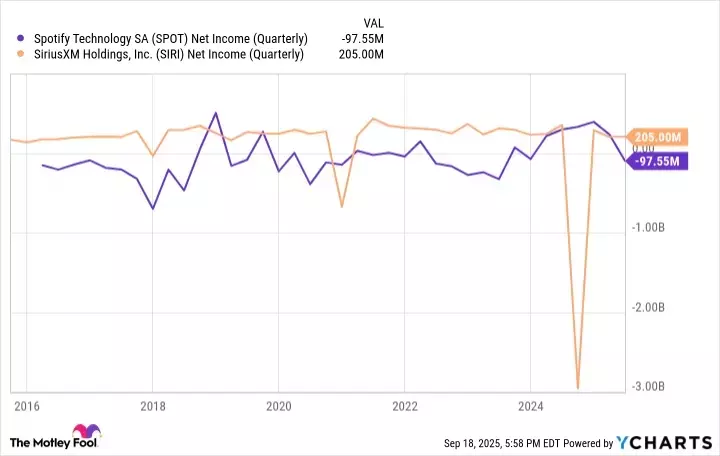
Despite Spotify's impressive growth metrics, an examination of the financial statements reveals a different narrative concerning profitability. SiriusXM consistently demonstrates strong profitability, with the exception of a single quarter in 2024, whereas Spotify continues to face challenges in achieving consistent earnings. This sustained profitability has enabled SiriusXM to adopt a more investor-centric approach compared to Spotify. Over the past decade, SiriusXM has actively reduced its outstanding share count by nearly 36% and offers a dividend that currently yields an attractive 4.7%. In an environment of decreasing interest rates, this dividend yield becomes even more appealing. When combined with its share repurchase initiatives, SiriusXM presents a more compelling investment proposition than initially perceived.
The Cost of Growth: Valuation Disparities Between Spotify and SiriusXM
The pursuit of growth, particularly in the case of Spotify, comes with a substantial price tag, as reflected in its market valuation. Currently, SiriusXM is trading at 0.9 times its sales, while investors are paying eight times sales for Spotify shares. Furthermore, SiriusXM's valuation is at one of its lowest points in the last decade, contributing to its attractive dividend yield. While it may not promise explosive growth, the company's consistent profitability and positive free cash flow make it a stable consideration for a diverse investment portfolio. Conversely, Spotify's valuation is near its decade-long peak. Without any capital returns to shareholders, investors must rely heavily on the continuation of robust growth to realize a profitable return on their investment. Ultimately, the choice between these two stocks hinges on an investor's objectives. Spotify offers greater potential for upside but carries increased risk at its current price. SiriusXM, on the other hand, provides stability and a steady dividend, fulfilling a distinct role within a well-balanced investment strateg
