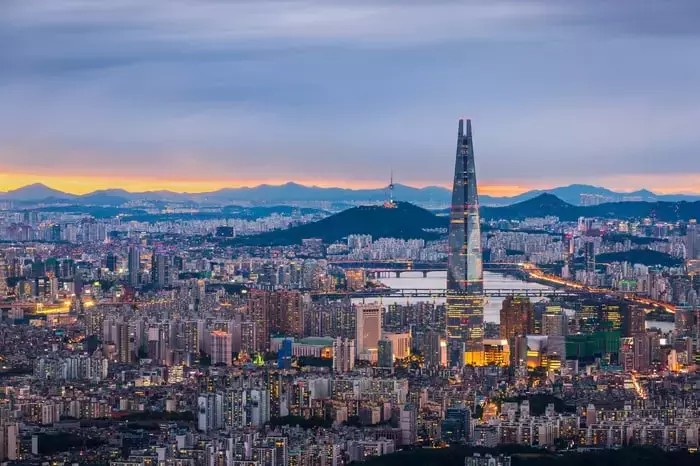
South Korea's equity market is currently undergoing a significant transformation, marked by a substantial uptick in performance. The nation's benchmark index, the Kospi, has seen a remarkable 48% increase this year. This impressive growth outpaces major global indexes, including the S&P 500 and Nasdaq. A key driver behind this resurgence is the newly elected President's strategic initiatives aimed at bolstering corporate governance and enhancing protections for investors. These reforms are directly confronting the historical undervaluation of Korean listed companies, known as the 'Korea discount.' The renewed confidence in the market has attracted considerable international investment, further fueling the rally.
South Korean Equities Experience Historic Rebound Fueled by Presidential Reforms and Global Investor Interest
In a compelling turn of events, South Korea's stock market has become a focal point for global investors, demonstrating extraordinary growth throughout the current year. The Kospi index, a barometer for the nation's economic health, has surged by an impressive 48% year-to-date. This performance significantly outstrips that of many leading international benchmarks, such as the S&P 500 and the Nasdaq, both of which have recorded approximately 15% gains over the same period.
Adding to this narrative of success, the iShares MSCI South Korea ETF, an exchange-traded fund that mirrors the performance of South Korea's large and mid-capitalization companies, has seen an even more dramatic ascent, climbing by 64% since the beginning of the year. This ETF provides diversified exposure to 82 Korean firms, with significant stakes in industry giants like Samsung Electronics (24%) and SK Hynix (14%), alongside other notable players in banking, aerospace, and internet services.
The catalyst for this robust market rally can be traced back to the election of President Lee Jae Myung in June, which brought an end to a period of political instability. President Lee has swiftly implemented a pro-market agenda, prioritizing enhanced corporate governance standards and committing to push the Kospi index past the 5,000-point mark during his tenure. Currently hovering around 3,550, this ambitious target underscores a firm resolve to elevate market valuations.
Key among President Lee's reforms is the commitment to eradicate the persistent 'Korea discount,' a phenomenon that has historically suppressed the valuations of Korean companies due to concerns over corporate transparency and shareholder rights. His administration has pledged to introduce stronger shareholder protections and revise capital gains tax thresholds on stocks to make the market more appealing. These measures have resonated positively with overseas investors, who have poured an estimated $11.5 billion into Korean equities since May, far surpassing historical investment levels.
Furthermore, South Korea is actively participating in the global AI boom, with leading technology companies such as Samsung Electronics and SK Hynix driving innovation in the semiconductor sector. This technological prowess, coupled with a more favorable regulatory environment, positions the country as an attractive destination for capital seeking growth opportunities.
Despite the prevailing optimism, potential challenges exist, including the possibility of new U.S. tariffs on South Korean goods. However, a recent agreement in July to lower tariffs to a manageable 15% offers a degree of stability and predictability for South Korean exports. Comparatively, Korean stocks remain attractively valued, with the Kospi's trailing 12-month price-to-earnings ratio at about 16.5, significantly lower than the S&P 500's 28. This valuation gap, traditionally influenced by corporate governance concerns, is now seen as an opportunity given the ongoing reforms.
The current market dynamics present a compelling case for investors to consider South Korean equities. With a dedicated presidential push for market reform, increased transparency, and strong global investor interest, the potential for sustained growth in the Korean market appears promising for those looking to capitalize on undervalued assets.
The current upward trajectory of the South Korean stock market, significantly influenced by President Lee Jae Myung's proactive reforms, provides valuable insights into the profound impact that strong leadership and policy commitments can have on investor confidence and economic performance. The initiative to address the 'Korea discount' through improved corporate governance and enhanced shareholder protections serves as a model for emerging markets seeking to attract global capital. It highlights that transparency, accountability, and investor-friendly policies are crucial for fostering a robust and competitive financial ecosystem. For investors, this scenario underscores the importance of monitoring political developments and regulatory changes, as they can be powerful determinants of market direction and investment opportunities. The rapid influx of foreign investment and the outperformance of key indices suggest that proactive governance can swiftly re-rate a nation's equity market, making it an attractive proposition for those willing to engage with evolving economic landscapes.
