
While the overall stock market is hitting new peaks, certain companies are struggling to keep pace. This report examines the recent downturns of Sweetgreen, a popular salad restaurant chain, and Figma, a design software innovator. Sweetgreen is grappling with substantial decreases in comparable store sales amid a tough economic environment, while Figma, despite its rapid expansion, is burdened by an exceptionally high market valuation. Although some investors might see these sharp drops as prime buying opportunities, both stocks appear to carry considerable risk and could experience further reductions in value.
Detailed Report: The Struggles of Sweetgreen and Figma in a Buoyant Market
In the current financial landscape, where major stock indices are frequently reaching unprecedented heights, the trajectories of Sweetgreen (NYSE: SG) and Figma (NYSE: FIG) present a contrasting narrative. Both companies have witnessed significant depreciation in their stock values, prompting a closer look at the underlying factors.
Sweetgreen, a purveyor of health-conscious fast-casual meals, is experiencing a particularly challenging period. The company's recent quarterly earnings report revealed a meager revenue increase, primarily attributed to the opening of new locations rather than organic growth. More alarmingly, same-store sales saw a steep 7.6% year-over-year decline, fueled by a 10.1% reduction in customer traffic. This downturn is potentially influenced by menu price adjustments and the broader macroeconomic headwinds, including inflationary pressures and a less favorable jobs market. Consequently, Sweetgreen has revised its full-year guidance, now anticipating a 4% to 6% drop in comparable store sales, a significant shift from its earlier projection of flat sales for 2025. Despite plans to inaugurate at least 40 new establishments, which may partially offset these declines, the company's revenue forecast has been lowered to $700 million to $715 million. Even after an almost 80% fall from its 52-week high, Sweetgreen's valuation remains a concern, trading at approximately 1.5 times its revenue guidance while still operating at a net loss, reporting a deficit of $23 million in the second quarter. The competitive nature of the fast-casual dining sector, coupled with a deteriorating economic outlook, suggests that Sweetgreen's stock may continue its downward spiral as it struggles to maintain sales.
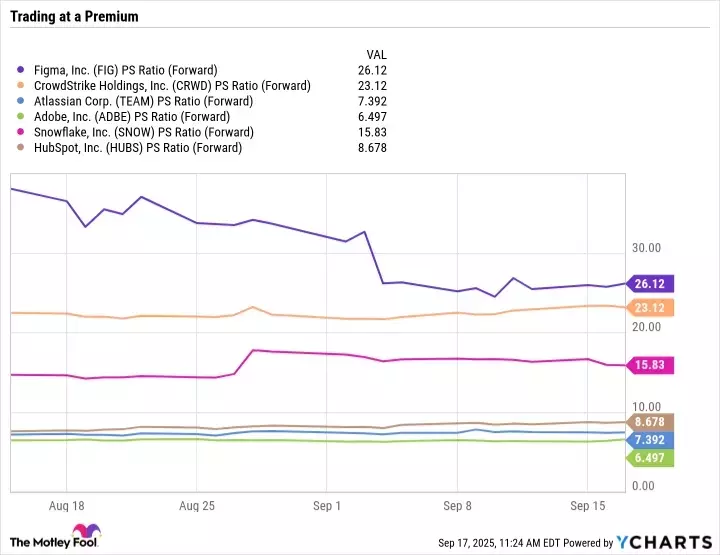
Figma, a prominent player in the design software industry, initially saw its stock surge post-IPO but has since retreated, shedding over 50% from its peak valuation. Despite this correction, the company's operational performance remains robust. Figma reported a strong 41% year-over-year revenue growth in the second quarter, complemented by an impressive net dollar retention rate of 129% for customers spending at least $10,000 annually. The company has also achieved profitability on a GAAP basis, posting a positive operating income in the same quarter. However, the primary concern for Figma's stock lies in its valuation. With a projected full-year revenue of up to $1.025 billion, its price-to-sales ratio stands above 25. While this figure is a reduction from the exorbitant levels observed shortly after its initial public offering, it still places Figma among the most highly valued software-as-a-service entities. In an uncertain economic climate, any deceleration in growth, perhaps triggered by businesses curbing non-essential expenditures, could lead to a further recalibration of Figma's stock price.
The current market conditions underscore the importance of discerning investment strategies. For companies like Sweetgreen and Figma, whose valuations are perceived as elevated or whose business models are particularly susceptible to economic fluctuations, even strong fundamental performance might not insulate them from investor skepticism. This highlights a critical lesson: a company's past success or growth potential must always be weighed against its current market valuation and the prevailing economic climate.
