
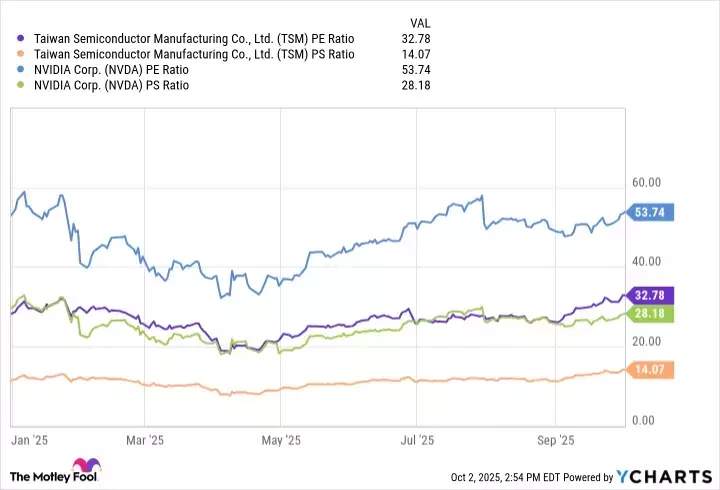
This analysis reveals that Taiwan Semiconductor Manufacturing Company (TSMC) is a pivotal entity within the global semiconductor landscape, underpinning the operations of technology giants like Nvidia. While Nvidia has garnered substantial attention and achieved impressive growth, TSMC's performance in 2025 has surpassed its peer, marking new milestones. The company's strategic focus on advanced chip manufacturing, combined with its robust market position and appealing financial metrics, makes it a noteworthy contender in the investment arena. Investors are encouraged to consider the intrinsic value and future potential of TSMC within a diversified portfolio, especially given its foundational role in the burgeoning AI and technology sectors.
Taiwan Semiconductor Manufacturing Company's Ascendance in the Global Chip Market
In the dynamic realm of semiconductor manufacturing, Taiwan Semiconductor Manufacturing Company (TSMC) has emerged as a formidable force, playing an indispensable role in the supply chain for leading technology firms, including the highly valued Nvidia. On October 6, 2025, industry insights from Patrick Sanders highlighted TSMC's exceptional market trajectory, demonstrating a 45% increase in stock value year-to-date, surpassing Nvidia's 41% gain over the same period. TSMC, renowned as the world's largest independent semiconductor foundry, specializes in producing advanced chips for a diverse clientele, such as Broadcom, Advanced Micro Devices, Apple, and Tesla, in addition to Nvidia. This pivotal position is underscored by its commanding 70% share of the foundry market, as reported by TrendForce.
TSMC's technological prowess is particularly evident in its production of 3-nanometer and 5nm chips, which constitute 60% of its revenue. The company's ability to mass-produce these minuscule, yet powerful, transistors is crucial for enhancing the capabilities of modern electronic devices. Furthermore, TSMC is on the verge of commencing mass production of its 2nm process this year, signaling continuous innovation and leadership in chip technology. Beyond high-performance computing, TSMC's semiconductors are integral to the widespread adoption of 5G communication and the functionality of Internet of Things (IoT) devices, including smart home products, wearables, electric vehicles, and sophisticated driver assistance systems.
Financially, TSMC reported an impressive second-quarter revenue of $30.07 billion, marking a 44.4% year-over-year increase, coupled with an outstanding net profit margin of 42.7%. Projections for the subsequent quarter anticipate further growth, with expected revenues ranging between $31.8 billion and $33 billion. The company is also undertaking a significant expansion initiative, investing $165 billion in new fabrication plants and facilities in Arizona. This strategic move aims to mitigate geopolitical risks and strengthen its presence in key global markets, particularly in response to governmental efforts to localize manufacturing capabilities.
Reflecting on the Significance of Foundational Technology Investments
This report on TSMC's remarkable performance and strategic importance within the semiconductor industry offers a profound insight into the often-overlooked foundational elements driving technological progress. It underscores that while companies like Nvidia capture headlines with their innovative products and soaring valuations, the underlying manufacturing capabilities provided by entities like TSMC are equally, if not more, critical. This situation reminds investors and industry observers alike to appreciate the symbiotic relationships within the tech ecosystem. The success of advanced AI, 5G networks, and future innovations relies heavily on the intricate and precise work performed by foundries. Furthermore, TSMC's attractive valuation, combined with its consistent dividend payouts, presents a compelling argument for diversifying investment portfolios beyond just the end-product innovators. It highlights the wisdom of investing in companies that provide essential services and infrastructure, which are poised to benefit from broad industry growth regardless of specific product cycles. Ultimately, this narrative suggests that a balanced investment strategy, encompassing both cutting-edge developers and their indispensable manufacturing partners, is key to navigating the complexities and capitalizing on the opportunities within the rapidly evolving technology sector.
