Taiwan Semiconductor Manufacturing Company (TSMC), a dominant force in the global semiconductor industry, stands at the forefront of technological advancement. Its pivotal role in supplying sophisticated chips to leading artificial intelligence (AI) firms underscores its importance in the current tech landscape. Driven by relentless innovation in chip design and manufacturing processes, TSMC is not merely participating in the AI revolution; it is actively powering it, making it a cornerstone for investors looking to capitalize on this transformative trend.
Taiwan Semiconductor Manufacturing Leads the Charge in Chip Innovation for AI Era
In a landscape increasingly defined by artificial intelligence, the role of advanced semiconductor manufacturing facilities has never been more critical. Taiwan Semiconductor Manufacturing Company, often referred to as TSMC, has firmly established itself as the world's preeminent independent semiconductor foundry. This strategic positioning allows it to be an indispensable partner for companies at the vanguard of AI development.
As of September 20, 2025, TSMC continues to demonstrate its market leadership. The company's unique ability to produce cutting-edge logic chips, which are the brains behind AI computing, has made it the go-to supplier for industry titans such as Nvidia, Advanced Micro Devices (AMD), and Broadcom. These collaborations are particularly significant given the enormous capital expenditures by AI hyperscalers on computing infrastructure, with projections indicating a spend of $600 billion this year alone. TSMC's revenue growth, which saw a 44% year-over-year increase in the second quarter, reaching $30.07 billion, is a direct reflection of this escalating demand.
TSMC's success is deeply rooted in its unwavering commitment to pioneering research and development. The company's current flagship offering includes 3-nanometer (nm) chips, renowned for their compact design and superior performance. Looking ahead, TSMC is not resting on its laurels. It plans to commence volume production of its next-generation 2nm chips before the close of 2025. This advancement promises a remarkable 50% reduction in the distance between electrical traces, leading to a substantial 25% to 30% decrease in power consumption for chips operating at comparable speeds. Such efficiency gains are paramount for energy-intensive data centers powering AI applications.
The innovation pipeline extends further, with the introduction of A16 node technology in 2026, targeting an additional 15% to 20% power improvement over its 2nm predecessor. Beyond that, the A14 technology is slated for production in 2028, signaling continuous strides in chip performance and efficiency. This relentless pursuit of innovation ensures TSMC's enduring relevance and dominance in an industry that demands constant evolution.
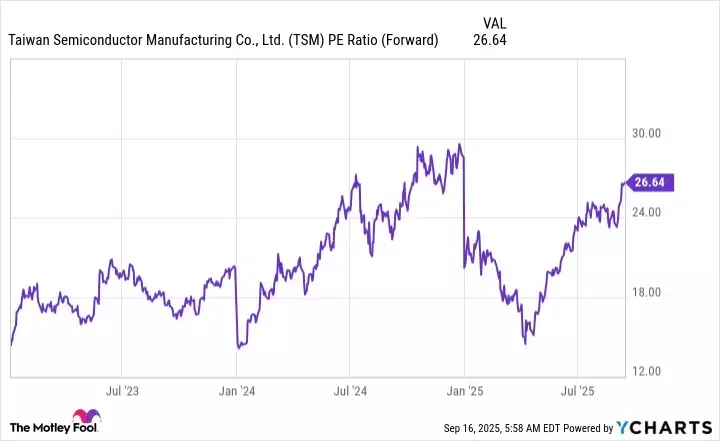
The anticipated boom in the AI market, with global data center capital expenditures potentially reaching $3 trillion to $4 trillion by 2030, paints a vibrant future for TSMC. As the primary supplier of the specialized computing units, like graphics processing units (GPUs), essential for AI, TSMC is poised for a corresponding period of robust growth. Despite its pivotal role and impressive growth trajectory, TSMC's stock currently trades at a forward earnings multiple of 26.6, which, while not inexpensive, offers a reasonable valuation compared to some of its AI hardware peers. This makes TSMC an attractive proposition for investors seeking to participate in the long-term growth of the AI sector, solidifying its status as a top semiconductor and AI stock to acquire now.
The trajectory of Taiwan Semiconductor Manufacturing Company provides profound insights into the future of technology. Its sustained leadership highlights that in a rapidly evolving sector, continuous innovation and strategic partnerships are not just advantageous but essential for survival and prosperity. The company's proactive approach to developing next-generation chip technologies, even as current advancements are being deployed, underscores a critical lesson: staying ahead requires constant foresight and investment in future capabilities. For industries reliant on cutting-edge hardware, TSMC's model demonstrates the power of specialization and a deep commitment to engineering excellence. This case study teaches us that true market leadership is built on a foundation of relentless progress and an unyielding dedication to empowering the technological breakthroughs of tomorrow.
