Target Corporation, a prominent retail giant, has recently encountered a series of operational and public relations difficulties, causing its stock value to plummet significantly from its peak in late 2021. These setbacks, including persistent supply chain disruptions, controversial shifts in diversity and inclusion policies, and a perceived misstep in CEO succession, have led to a substantial erosion of investor confidence. While the company grapples with declining sales and profits, its extensive physical footprint and a historically strong dividend program offer potential avenues for a future rebound. This analysis delves into the various factors influencing Target's current predicament and assesses its prospects for a successful revitalization in the competitive retail landscape over the coming half-decade.
For several years, Target has been struggling to maintain its appeal to the investment community. The stock has experienced a sharp decline, losing approximately two-thirds of its value since its highest point in November 2021. This performance stands in stark contrast to the S&P 500, which has seen its total returns more than double over the same five-year period. The pressing question now is whether Target can surmount these obstacles in the foreseeable future or if it is destined to continue alienating investors.
The current challenges facing Target are multifaceted and have contributed to its weakening market position. The company has grappled with elevated inventory levels stemming from supply chain disruptions earlier in the decade, a problem that continues to affect its operations. Additionally, its fluctuating approach to diversity, equity, and inclusion initiatives has drawn criticism from various stakeholders, further complicating its public image and potentially alienating a segment of its customer base. A key point of contention among investors was the announcement of Michael Fiddelke, the former COO, as the new CEO in February. Many investors had expressed a preference for an external leader to steer the company through its turbulent times, making Fiddelke's task of restoring confidence particularly demanding. Sales figures reflect these difficulties, as Target's net sales in the first half of fiscal year 2025 (ending August 2) decreased by 2% year-over-year, reaching $49 billion. This decline occurred while major competitors like Walmart and Costco reported positive sales growth, highlighting Target's underperformance. The company's cost of sales did not decrease proportionally, and depreciation and amortization costs actually rose, leading to an 8% decline in earnings, which totaled nearly $2 billion in the first half of the year. Furthermore, Target anticipates a 'low single-digit decline in sales' for the full fiscal year 2025, although analysts project a 2% increase in net sales for fiscal year 2026. These ongoing struggles have led some to ponder if Target might follow the path of once-dominant but now struggling retailers such as Sears and JCPenney.
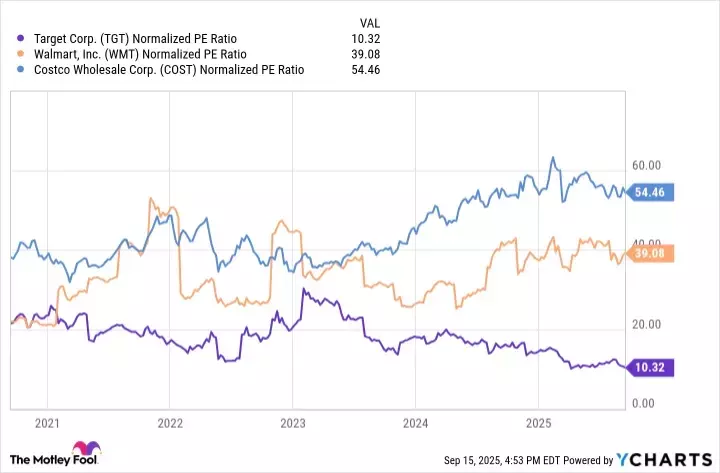
Despite the existing challenges, there are compelling reasons to believe in Target's potential for a comeback. The notion that Target might become another failed retailer like Sears is likely an exaggeration. One significant competitive advantage is Target's expansive physical presence, with nearly 2,000 stores spread across all 50 U.S. states. This broad reach means that over 75% of Americans reside within ten miles of a Target store, a proximity surpassed only by Walmart. This extensive network positions Target favorably for omnichannel retail strategies, particularly as CEO Michael Fiddelke has indicated plans to add approximately 300 more stores. Moreover, Target's dividend policy is a powerful draw for investors. The company's annual payout of $4.56 per share translates to a dividend yield of 5.1%, which is more than four times the S&P 500 average of 1.2%. With 54 consecutive years of annual dividend increases, Target holds the prestigious 'Dividend King' status. Such a long-standing commitment to dividend growth is typically maintained vigorously by companies, as any deviation can trigger prolonged stock sell-offs. Fortunately, Target appears well-equipped to sustain its dividend. Over the past twelve months, dividend payments amounted to just over $2 billion, while the company generated over $2.9 billion in free cash flow, comfortably covering its dividend obligations and allowing for future increases. Finally, investors should consider Target's valuation. Its price-to-earnings (P/E) ratio of 10 is significantly lower than the S&P 500 average of 31. Given that its main competitors trade at much higher earnings multiples, Target's stock might represent an undervalued opportunity despite its current difficulties.
Considering these points, Target, while facing a complex road ahead, is well-positioned for a turnaround and could potentially outperform the broader market in the next five years. The immediate outlook for positive growth remains somewhat ambiguous, and Fiddelke's efforts to gain investor confidence will take time. Nevertheless, the company's vast store network and projected store expansion plans enhance its ability to capitalize on both physical and digital retail channels. Furthermore, its high, reliable dividend, backed by its Dividend King status and robust free cash flow, is likely to remain attractive to income-focused investors. Given the stock's current valuation at just ten times earnings, any operational improvements are expected to drive its share price upward during this period.
