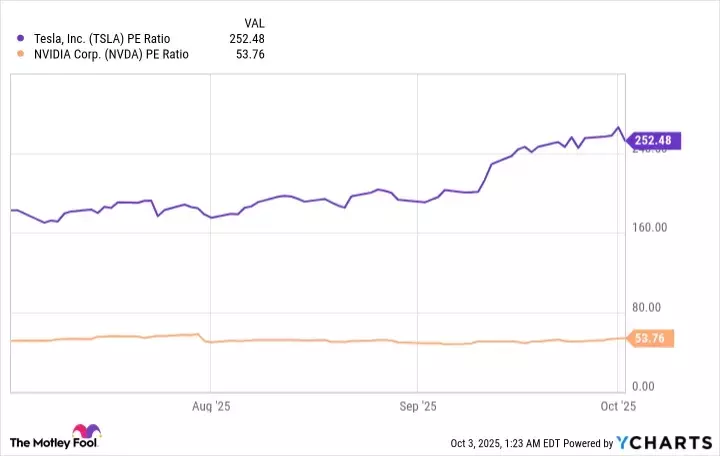

Tesla, a prominent electric vehicle manufacturer, recently reported a notable increase in its third-quarter EV sales for 2025. This surge followed a period of declining sales and market share losses, particularly to more budget-friendly brands such as BYD. Despite the positive sales figures, industry analysts suggest that this rebound might be partly attributed to consumers expediting purchases to capitalize on expiring tax incentives. The company's stock, currently trading at a premium valuation, appears to be primarily buoyed by investor optimism surrounding its forthcoming innovations like the Cybercab robotaxi and the Optimus humanoid robot, rather than its immediate performance in the competitive EV market.
In the initial half of 2025, Tesla experienced a 13% year-over-year reduction in vehicle deliveries, totaling 720,803 units. This downturn marked a significant shift, especially after 2024 saw the first annual decline in sales since the introduction of the Model S in 2011. The escalating competition, particularly from companies like BYD, has been a major factor. In Europe, where overall EV sales are expanding, Tesla's market share has dwindled, while BYD has seen rapid growth, even surpassing Tesla in sales during July and August. This trend highlights a consumer shift towards more affordable electric vehicle options.
However, the third quarter of 2025 brought a welcome change, with Tesla delivering 497,099 EVs globally, marking a 7% increase from the previous year. While seemingly a strong indicator of recovery, this boost coincided with the expiration of a $7,500 U.S. government EV tax credit on September 30. This timing suggests that many American consumers might have accelerated their purchasing decisions to benefit from the incentive, potentially borrowing sales from the upcoming fourth quarter. Consequently, the period from October to December could experience weaker sales, particularly within the U.S. market.
Tesla's current stock valuation, which is considerably higher than the Nasdaq-100 technology index and even industry leaders like Nvidia, underscores the market's focus on its future ventures. The company's earnings actually declined by 31% in the first half of the year due to subdued EV sales, making its elevated price-to-earnings (P/E) ratio of approximately 252 difficult to justify based on current financial performance. Investors are largely placing their bets on the long-term success of transformative products such as the Cybercab and Optimus.
The Cybercab, intended to leverage Tesla's full self-driving (FSD) technology, aims to establish a high-margin revenue stream through autonomous ride-hailing services. Despite plans for mass production by 2026, Tesla's FSD software has yet to receive approval for unsupervised use in the U.S., placing it behind competitors like Alphabet's Waymo, which already conducts a substantial number of paid autonomous trips. Similarly, the Optimus humanoid robot, envisioned by CEO Elon Musk to generate trillions in revenue, faces a longer development timeline, with significant market penetration potentially taking years to achieve, assuming demand materializes. These ambitious projects carry considerable uncertainty, and their success is crucial to validating Tesla's current market capitalization.
The significant optimism surrounding Tesla's future product pipeline, including the Cybercab and Optimus, primarily underpins its elevated stock valuation. While these innovations hold the promise of long-term growth and new revenue streams, their development and market adoption are still in early stages. The recent surge in third-quarter sales, possibly influenced by a temporary tailwind from tax credits, does not fully address the underlying challenges in its core EV market or justify its current premium P/E ratio. Therefore, the stock remains susceptible to market corrections if these future ventures do not meet the high expectations set by investors within a reasonable timeframe.
