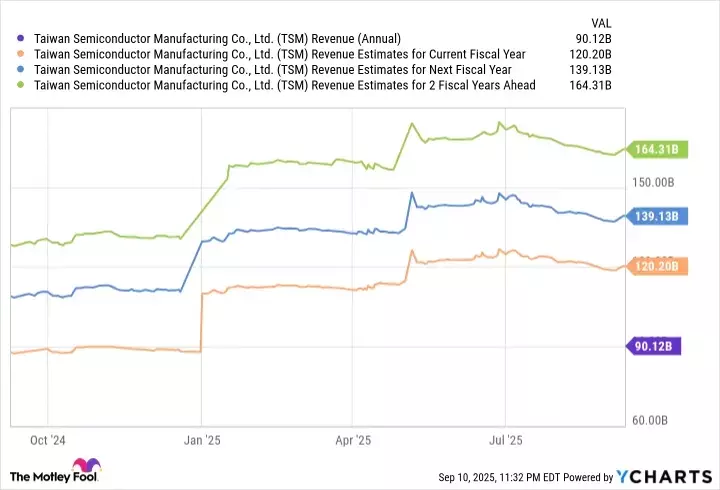

Taiwan Semiconductor Manufacturing Company (TSMC), a dominant force in the global semiconductor industry, is currently valued at around $1 trillion. This analysis delves into the feasibility of TSMC reaching a $2 trillion valuation by 2028, examining its unparalleled market leadership, robust financial performance, and pivotal involvement in the artificial intelligence revolution. The article also addresses potential external factors, such as geopolitical tensions, that could influence its future growth.
TSMC's Dominance and Future Growth Prospects
In a dynamic global economy where trillion-dollar valuations are increasingly common, Taiwan Semiconductor Manufacturing Company (TSMC) stands out as a critical player. As of September 17, 2025, TSMC, with a market capitalization of approximately $1 trillion, is being closely watched for its potential to double this figure within the next three years. This ambitious projection is rooted in the company's foundational role as the world's premier pure-play semiconductor foundry.
TSMC's business model is unique: it focuses exclusively on manufacturing chips designed by other technology giants, including industry leaders such as Nvidia and Apple, as well as semiconductor firms like Advanced Micro Devices. This specialization has allowed TSMC to build an impressive competitive advantage. Data from research firm TrendForce indicates that TSMC commands about 70% of the global foundry market. Furthermore, Counterpoint Research reported that in the first quarter of 2025, TSMC held approximately 35% of the advanced chip foundry market. To underscore its market leadership, TSMC's second-quarter 2025 foundry revenue exceeded $30 billion, dwarfing its closest competitor, Samsung, which reported around $3.16 billion in foundry revenue.
The company's sustained dominance is attributed to the strategic vision of its founder, Dr. Morris Chang, and his successors, who have consistently demonstrated superior operational execution. This has cultivated a substantial competitive moat in the advanced chip sector, frequently positioning TSMC as the primary, or even exclusive, supplier for the most sophisticated chips available. For TSMC to achieve a $2 trillion valuation by 2028, it would need to nearly double its net income from the projected $48 billion in 2025 to approximately $90 billion to $100 billion. Analysts forecast high-teens percentage revenue growth through 2027, supported by the company's impressive profit margins, suggesting that this growth trajectory is within reach, provided current market conditions persist.
However, the path to $2 trillion is not without obstacles. Geopolitical tensions, particularly between China and Taiwan, represent a significant ongoing concern. These tensions influenced investor decisions, such as Warren Buffett's divestment of a majority of his TSMC holdings a few years prior. The broader geopolitical climate between China and the U.S. also poses risks, exemplified by the recent revocation of fast-track export licenses for U.S. chipmaking equipment to TSMC's primary Chinese facility. Conversely, TSMC is at the forefront of the artificial intelligence (AI) boom. As AI models become more complex and computational demands surge, the demand for TSMC's advanced chips is expected to escalate. The upcoming production of 2-nanometer chips, which promise 25% to 30% lower power consumption than current 3nm chips at comparable speeds, is anticipated to further solidify TSMC's indispensable role in the AI ecosystem. The interplay of these powerful market tailwinds and potential geopolitical headwinds will ultimately determine whether TSMC can reach the coveted $2 trillion milestone within the projected timeframe.
The journey of TSMC towards a $2 trillion valuation highlights the intricate balance between technological innovation, market dominance, and geopolitical stability. This case study offers valuable insights into the complexities of global supply chains and the strategic importance of semiconductor manufacturing in the modern era.
