
Taiwan Semiconductor Manufacturing Company (TSMC) stands at the forefront of the artificial intelligence revolution, providing the critical foundational technology that powers the world's most advanced AI systems. As a leading independent semiconductor foundry, TSMC's innovations in chip manufacturing are not just supporting, but actively driving the rapid evolution of AI across diverse applications, from high-performance data centers to smart devices. The company's strategic vision and relentless pursuit of miniaturization and efficiency in chip design position it as an indispensable partner for the tech giants shaping our future.
Pioneering the Future of AI with Advanced Semiconductor Technology
The Foundational Role of Semiconductors in AI Advancement
The semiconductor industry forms the backbone of artificial intelligence, facilitating every aspect of its development and deployment. From the rigorous training of sophisticated AI models to the execution of inference tasks in large-scale data centers and the integration of AI capabilities into personal devices, semiconductor components perform the essential, high-speed computations required. These intricate operations demand immense processing power, a requirement met by a variety of specialized chips, including central processing units (CPUs), graphics processing units (GPUs), and application-specific integrated circuits (ASICs).
TSMC's Unrivaled Position in Chip Fabrication
While numerous companies excel in designing these cutting-edge chips, such as industry leaders like Nvidia, Advanced Micro Devices, and Broadcom, their designs rely heavily on external manufacturing capabilities. This is where Taiwan Semiconductor Manufacturing Company, widely known as TSMC, plays its pivotal role. As the primary foundry partner for these fabless chipmakers, TSMC is responsible for the actual production of the physical chips. The company's pioneering efforts have been instrumental in propagating semiconductor technology globally, establishing it as arguably the most critical entity in the entire semiconductor ecosystem due to its profound influence on the future trajectory of the AI industry.
Enhancing AI Capabilities Through Advanced Process Nodes
TSMC's fabrication facilities employ a range of process nodes, each representing a specific level of technological advancement. More advanced nodes allow for the integration of a greater number of transistors onto a single chip, leading to a significant boost in computing power while simultaneously reducing energy consumption. For instance, Nvidia's A100 data center GPU, crucial for training systems like ChatGPT, was produced using TSMC's 7-nanometer (nm) process. Subsequently, Nvidia's latest generation of Blackwell AI GPUs leverages TSMC's 4nm process, yielding substantial improvements in performance and power efficiency compared to its 5nm predecessor.
This continuous progression in process technology by TSMC directly translates into enhanced capabilities for AI chip designers. By utilizing TSMC's more sophisticated nodes, companies can develop chips capable of training larger and more complex AI models and executing AI inference tasks within data centers with greater efficiency. In an era where AI models are rapidly advancing and concerns about the energy footprint of AI data centers are growing, the demand for the high-performance, energy-efficient computing chips manufactured by TSMC is only set to intensify. This technological leadership has cemented TSMC's dominant market position, with the company consistently expanding its share of the global foundry market, far surpassing its nearest competitors.
The Horizon of Semiconductor Innovation: TSMC's Future Roadmaps
TSMC is not merely resting on its current achievements but is actively pushing the boundaries of what is technologically possible. Its 3nm nodes are already in widespread use by major chip developers like Apple and Qualcomm. Looking ahead, the company anticipates initiating production on an even more advanced 2nm process node this year, promising a 15% increase in transistor density over the 3nm node, alongside a 25% to 30% reduction in power consumption and a 10% to 15% enhancement in performance. The innovation pipeline extends further, with management projecting a transition to a 1.6nm chip node by late 2026, followed by a 1.4nm node in 2028. The 1.4nm process is expected to deliver up to a 15% speed improvement at equivalent power levels, or a 30% power reduction at the same speed, coupled with over a 20% increase in logic density compared to the 2nm process. Ultimately, TSMC aims to achieve a 1nm node by 2030.
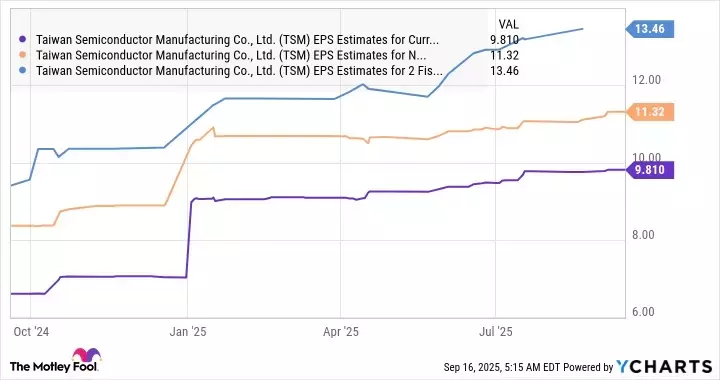
This aggressive roadmap signifies that TSMC's customers will have access to increasingly powerful and energy-efficient chips in the coming years. Such continuous innovation is likely to further consolidate TSMC's leadership in the global foundry market, paving the way for sustained, exceptional growth. Analysts' consensus estimates already reflect an accelerating earnings growth trajectory for TSMC. Should the company maintain a 20% annual earnings growth rate through 2029 and 2030, its earnings per share could reach approximately $19.38 by 2030. When combined with a forward earnings multiple typical of the tech-heavy Nasdaq-100 index, this suggests a potential stock price of around $511 within five years, representing a substantial increase from current levels. Given its attractive valuation, TSMC stock presents a compelling investment opportunity for those looking to capitalize on the ongoing AI boom and the company's pivotal role in shaping the future of technology.
