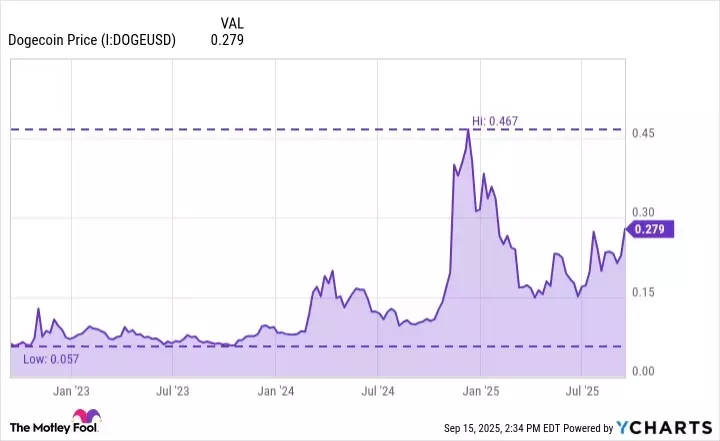

Dogecoin, a prominent yet controversial cryptocurrency, frequently exhibits significant price fluctuations driven primarily by social dynamics and online fervor rather than conventional financial indicators. Historically, its value has experienced substantial surges and subsequent retractions, with a notable instance occurring in late 2024. While currently trading at a moderate level, understanding its inherent speculative nature is crucial for investors. This analysis delves into the factors influencing Dogecoin's market behavior and provides insights into its potential future trajectory, emphasizing the importance of caution for those considering it as an investment.
Unlike established cryptocurrencies such as Bitcoin and Ethereum, which derive their value from scarcity or technological utility, Dogecoin's origins as a 'meme coin' tie its market movements more closely to internet culture and high-profile endorsements. This unique characteristic means its price is less predictable through traditional financial analysis. Instead, it often reacts sharply to viral online discussions or celebrity mentions, leading to rapid, yet often short-lived, price increases. This distinction positions Dogecoin as a high-risk, high-reward asset, appealing to investors seeking speculative gains rather than stable, long-term growth.
A significant event demonstrating Dogecoin's sensitivity to external narratives was its dramatic price surge in November 2024. This occurred shortly after the U.S. presidential election, when then-President-elect Donald Trump and Tesla CEO Elon Musk announced the 'Department of Government Efficiency' (D.O.G.E.). The acronym's coincidental alignment with Dogecoin's ticker symbol fueled widespread speculation about potential government ties or endorsements, despite a lack of any real connection. This incident vividly illustrates how a narrative, however unfounded, can trigger substantial market movements for Dogecoin, highlighting its reliance on social sentiment over fundamental utility.
Following this surge, Dogecoin's price eventually retreated, returning to a more moderate trading range. This pattern of rapid ascent followed by a correction is typical for Dogecoin, underscoring its role as a speculative instrument. Its value oscillates between periods of intense hype and subsequent re-evaluations, making it a challenging asset for consistent valuation. The influence of public figures like Elon Musk, who has a history of engaging with Dogecoin on social media, continues to play a significant role in shaping these speculative cycles.
Currently, Dogecoin's price hovers around the $0.28 mark, placing it above its previous lows but still considerably below its peak values from a year prior. Experts suggest that renewed momentum in the broader cryptocurrency market could potentially push its price towards $0.30 to $0.35. Conversely, a 'crypto winter' scenario might see its value drop back to around $0.15. These projections, however, are largely contingent on market sentiment and community engagement, rather than any intrinsic value or business development, reinforcing its speculative nature.
Investing in Dogecoin is often compared to purchasing a lottery ticket, where outcomes are heavily dependent on timing and chance rather than a well-researched strategy. While it may offer intermittent periods of excitement and potential quick gains, its history consistently shows that these gains are frequently surrendered once the initial hype fades. Given its inherent unreliability and susceptibility to narrative-driven volatility, exercising extreme caution is advised for anyone considering Dogecoin for their investment portfolio. For investors focused on generating lasting wealth, more established cryptocurrencies or traditional assets might present more prudent options.
