
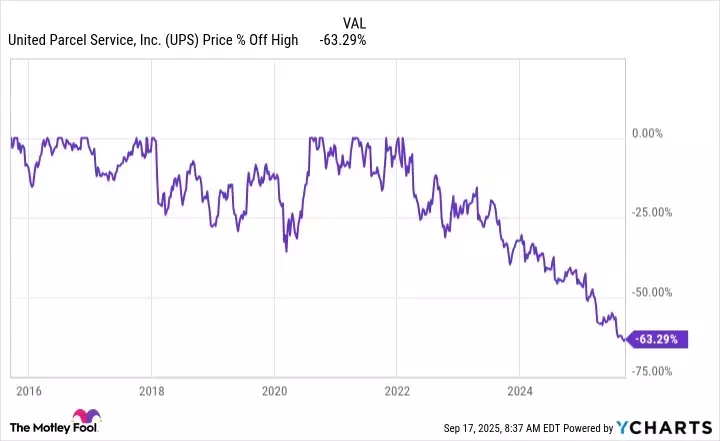
United Parcel Service, a prominent global logistics provider, is undergoing a significant transformation. Despite its essential role in package delivery, the company's stock has seen a considerable downturn from its 2022 peaks. This decline is attributed to a combination of factors, including an inflated demand during the pandemic that subsequently normalized, and UPS's proactive measures to modernize its business. The company is strategically focusing on high-profit segments and enhancing its technological infrastructure, which involves shedding less lucrative partnerships, such as certain delivery services for Amazon. These bold strategic shifts, aimed at long-term profitability, have temporarily impacted revenue and increased costs, leading to investor apprehension. However, for those with a long-term investment horizon, the current undervaluation, coupled with the company's robust underlying business and strategic recalibration, could present a unique buying opportunity.
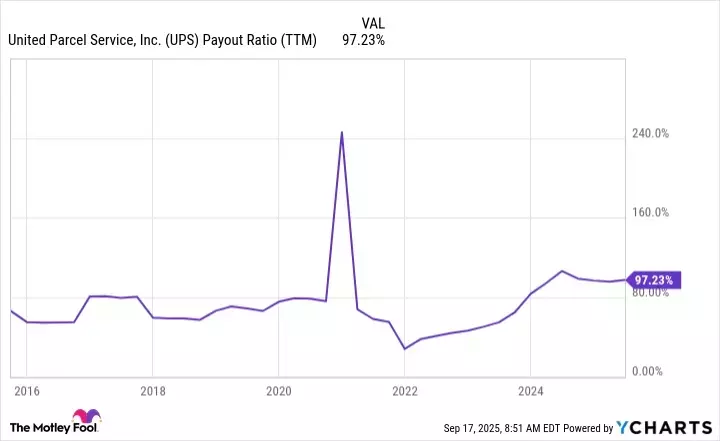
A notable aspect of UPS's current investment profile is its high dividend yield, which has prompted concerns about its sustainability. Historically, UPS has consistently increased its dividends for 16 years, but its payout ratio is nearing 100%, indicating potential strain. While a dividend cut is a possibility as the company navigates its business overhaul, even a substantial reduction would still leave the yield competitive compared to broader market averages like the S&P 500. This suggests that while a dividend reset might occur, a complete elimination is unlikely, making UPS an appealing prospect for income-focused investors willing to accept some short-term volatility. The ongoing modernization is expected to fortify the company's profitability and market position, making it a compelling turnaround story for discerning investors.
Understanding UPS's Business Model and Market Position
United Parcel Service (UPS) operates as a global behemoth in the logistics sector, primarily known for its extensive package delivery services. The company's core strength lies in its unparalleled network and logistical expertise, facilitating the seamless movement of goods across diverse geographies. This intricate operation encompasses everything from package collection at various points, sophisticated routing mechanisms utilizing air and ground transportation, to the final doorstep delivery. The sheer scale and complexity of UPS's infrastructure make it incredibly difficult for new entrants or even large existing players, such as Amazon, to replicate its capabilities entirely. This enduring necessity for efficient package delivery, driven by global commerce and interconnected populations, positions UPS as a fundamentally resilient enterprise, potentially offering a cornerstone investment for life-long portfolios.
UPS's business model, though seemingly straightforward in its objective of moving packages, is a masterclass in operational efficiency and strategic resource allocation. The company's continuous investment in technology and its vast network of sorting facilities, vehicles, and personnel underscore its commitment to maintaining a competitive edge. This has enabled UPS to handle a massive volume of packages daily, ensuring timely and cost-effective delivery. The long-term viability of package delivery, irrespective of economic cycles, reinforces UPS's role as a critical component of global supply chains. For investors, this inherent demand and the company's established dominance in the logistics space provide a strong foundation, suggesting that despite short-term market fluctuations, UPS's fundamental business remains robust and indispensable.
Navigating Market Volatility and Dividend Sustainability
The recent market performance of UPS stock has been marked by significant volatility, with its value plummeting by 60% from its 2022 peak. This sharp decline can be primarily attributed to two factors: an overestimation of pandemic-driven demand for package delivery, which subsequently normalized, and the company's strategic decision to modernize its operations. Investors had initially extrapolated the surge in package volumes during the COVID-19 lockdowns far into the future, leading to an inflated stock valuation. As global economies adapted and demand stabilized, the stock price corrected. Concurrently, UPS initiated a comprehensive business overhaul, including technological upgrades, consolidation of less efficient distribution centers, and a shift towards higher-margin business segments, notably reducing its dependence on low-profit Amazon deliveries. These strategic adjustments, while essential for long-term health, have introduced short-term financial pressures and revenue contractions.
A critical consideration for potential investors is the sustainability of UPS's attractive dividend yield, which currently stands at an enticing 7.7%. While the company boasts a commendable 16-year history of annual dividend increases, its payout ratio is approaching 100%, raising concerns about a potential dividend cut. This elevated payout ratio, combined with the ongoing business transformation and associated costs, suggests that a dividend reset is a distinct possibility. However, even in the event of a significant dividend reduction, for instance, a 50% cut, the revised yield would still offer a compelling return compared to the broader market, which typically yields around 1.2%. For investors who prioritize long-term capital appreciation and are less concerned about immediate dividend stability, the current depressed stock price, coupled with the company's strategic repositioning, could represent a valuable entry point into a company poised for renewed growth and efficiency.
