
This article examines the current challenges and strategic responses of United Parcel Service (UPS) in 2025, detailing its stock performance, cost-saving initiatives, and market outlook.
UPS: Charting a Course Through Market Headwinds and Strategic Transformation
Understanding the Recent Dip in UPS Stock Performance
United Parcel Service, a globally recognized leader in shipping and logistics, has experienced a notable downturn in its stock valuation during 2025. The company's shares have depreciated by approximately 30% this year, a performance that lags behind the broader market index. This decline follows a period of robust growth in the early stages of the pandemic, with several factors contributing to the current challenges. These include a strategic reduction in its engagement with large e-commerce clients, declining profit margins, and uncertainties stemming from international trade tariffs.
The Optimistic Outlook: Efficiency and Strategic Repositioning
Despite the recent setbacks, there are compelling reasons for a positive long-term view of UPS. The company maintains one of the world's most sophisticated and efficient logistics infrastructures. A key driver for future optimism is UPS's ongoing commitment to enhancing operational efficiency through a comprehensive cost-reduction strategy, aptly named \"better, not bigger.\" This initiative targets substantial savings, estimated at $3.5 billion in 2025, through workforce adjustments and facility consolidation. Furthermore, UPS is strategically reorienting its business model by scaling back on less profitable consumer parcel deliveries and prioritizing higher-margin segments such as healthcare logistics and services for small and medium-sized businesses. This pivot is designed to bolster profitability over time.
Technological Advancements and Margin Improvement Efforts
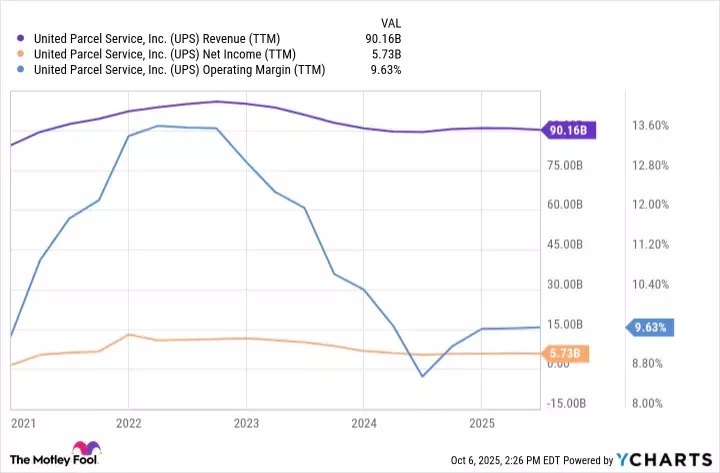
In parallel with its cost-cutting measures, UPS is significantly investing in advanced automation technologies and sophisticated data analytics. These technological adoptions are crucial for streamlining delivery processes, reducing operational expenditures, and ultimately improving service speed and reliability. Although the company's operating margins have contracted since 2022, these strategic investments are expected to reverse this trend and contribute to enhanced financial performance in the coming years, reinforcing the company's competitive edge.
Identifying the Key Risks and Market Uncertainties
While UPS is actively pursuing its strategic objectives, the immediate future is not without its uncertainties. The volume of daily package shipments within the United States has shown a downward trend this year, coinciding with tighter operating margins. The imposition of tariffs has further complicated the business environment, leading the company to refrain from providing a full-year financial forecast for 2025. These external pressures and market dynamics present considerable risks that could impact the pace and success of UPS's turnaround efforts.
Investment Considerations: Bargain or Caution?
Currently, UPS stock is trading at roughly 14 times its projected future earnings. This valuation suggests that while it may not be perceived as an outright bargain, the stock could be undervalued if the ongoing cost-reduction and efficiency-boosting strategies prove successful. For investors drawn to the potential for significant recovery and a generous dividend yield, which currently exceeds 7%, UPS may represent an attractive opportunity. However, those prioritizing market stability and clearer indicators of a sustained upturn might prefer to defer investment until more conclusive signs of a financial rebound emerge. This mixed outlook requires careful consideration of both the inherent value and the prevailing market risks.
