
This analysis reveals how the Vanguard S&P 500 Growth ETF has consistently outperformed the traditional S&P 500 index since its establishment in 2010. By strategically focusing on a concentrated portfolio of high-growth companies, particularly those benefiting from the artificial intelligence boom, the ETF has delivered significantly higher returns. This performance highlights the impact of targeted investment in dynamic market segments, suggesting a promising outlook for its continued success in the coming years, provided current market trends persist.
The S&P 500, a benchmark for the broader market, has historically shown an average annual compound return of approximately 10.5% since its inception in 1957. In the current year, 2025, it has already exceeded this average with a 12.2% gain. However, for investors who opted for the Vanguard S&P 500 Growth ETF (VOOG), the returns have been even more impressive, reaching 17.6% over the same period. This notable difference underscores the advantage of investing in a fund that specifically targets growth-oriented companies.
The Vanguard S&P 500 Growth ETF tracks the S&P 500 Growth index, which is composed of only 212 top-performing growth stocks selected from the broader S&P 500. This selective approach means that the ETF assigns a higher weighting to industry leaders, such as Nvidia, which significantly contributes to its superior performance. The index's quarterly rebalancing mechanism ensures that only companies meeting its stringent growth and momentum criteria remain, while underperforming ones are replaced by more suitable candidates. This dynamic adjustment is a core reason for its consistent outperformance compared to the standard S&P 500.
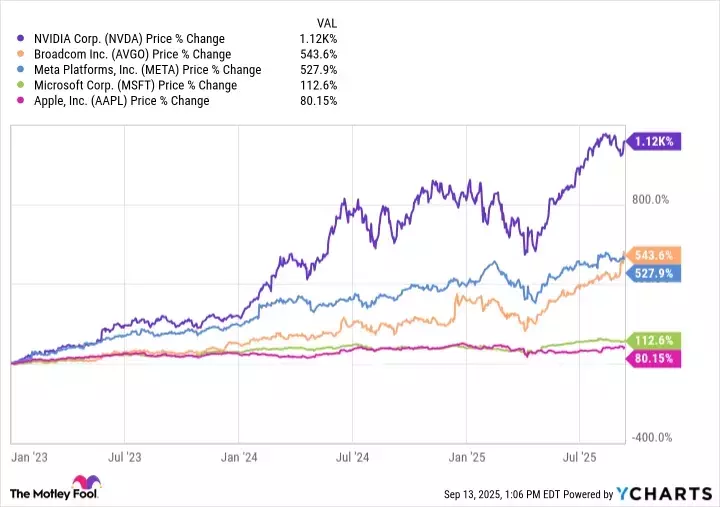
A critical factor driving the ETF's success in recent years has been its substantial exposure to artificial intelligence (AI) stocks. The market's excitement around AI has translated into significant gains for companies at the forefront of this technology. The Vanguard S&P 500 Growth ETF's top five holdings, including Nvidia, Microsoft, Meta Platforms, Apple, and Broadcom, collectively account for 37.3% of its portfolio. In contrast, these same stocks represent only 26.5% of the S&P 500. This higher concentration in AI powerhouses is particularly impactful given that these five companies have seen an average return of 476% since early 2023, coinciding with the rapid acceleration of the AI sector.
Beyond these top five, the ETF also includes other significant AI players like Alphabet, Amazon, Tesla, Oracle, and Palantir Technologies among its leading 20 holdings. This broad yet focused exposure to the AI ecosystem positions the Vanguard ETF strongly for future gains. Nvidia CEO Jensen Huang's projection of $4 trillion in spending on AI infrastructure and chips over the next five years suggests a sustained period of growth for hardware suppliers. Furthermore, the expected returns from these massive investments in data centers imply continued expansion in the software side of AI as well.
Since its launch in 2010, the Vanguard S&P 500 Growth ETF has achieved a compound annual return of 16.5%, significantly surpassing the S&P 500's 13.7% over the identical timeframe. While a 2.8 percentage point difference might seem minor, the effects of compounding have led to a substantial disparity in wealth accumulation. For instance, an initial investment of $50,000 in the Vanguard ETF in 2010 would have grown to approximately $494,150, whereas the same investment in the S&P 500 would have reached around $343,065. This stark contrast highlights the significant long-term benefits of investing in a growth-focused strategy.
Looking ahead to 2026, the Vanguard ETF is projected to continue outperforming the S&P 500, especially if leading AI companies such as Nvidia, Microsoft, Meta, and Broadcom maintain their strong market momentum. While potential economic downturns or a failure of AI to meet its lofty expectations could lead to sharp corrections in high-growth stocks, current economic indicators do not suggest an imminent severe recession. Therefore, with no severe downturn on the immediate horizon, the Vanguard S&P 500 Growth ETF is well-positioned for another successful year.
