
Walmart, a global retail powerhouse, has consistently rewarded its investors over the past decade. Yet, as the company matures and its stock valuation climbs, questions arise about its capacity to deliver similar market-beating returns. Despite its extensive U.S. presence, a robust online strategy, and an impressive dividend history, Walmart faces intense competition and challenges in international markets. This analysis delves into Walmart's current financial standing and future prospects, contrasting its valuation with key competitors to determine if it remains a compelling investment opportunity.
Walmart's Performance and Future Prospects: An Investor's Guide
In a detailed assessment published on September 25, 2025, by financial analyst Will Healy, the investment landscape surrounding Walmart (NYSE: WMT) was thoroughly examined. Walmart, originating from humble beginnings in rural Arkansas, has evolved into a global retail behemoth. Over the past decade, the company has delivered substantial returns for its shareholders. However, its rapid growth phase is largely considered to be in the past, with its current market capitalization exceeding $815 billion. The analysis highlights that Walmart's stock has become notably expensive, trading at a price-to-earnings (P/E) ratio of 39, which surpasses that of Amazon (35x earnings) and significantly exceeds its competitor Target (10x earnings). This elevated valuation prompts investors to question the potential for future market outperformance.
Despite these valuation concerns, Walmart maintains several strengths. Approximately 90% of U.S. consumers reside within ten miles of a Walmart store, underscoring its unparalleled domestic market penetration. Furthermore, its Sam's Club division stands out as a highly successful warehouse retailer, rivaling Costco. Although some international expansion efforts outside North America have faltered, Walmart has achieved considerable success in online retailing, particularly as global consumers increasingly embrace its low-price model.
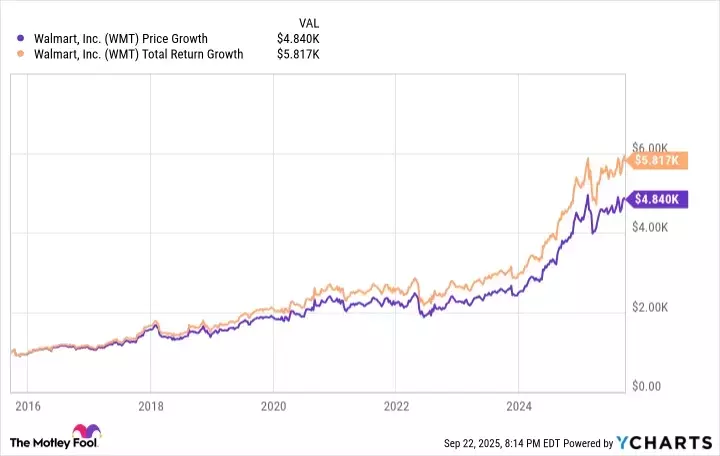
Investors also benefit from Walmart's consistent dividend. With annual payments of $0.94 per share, the current dividend yield is 0.9%. More impressively, Walmart boasts a 52-year streak of consecutive annual dividend increases, securing its status as a 'Dividend King.' Historical data reveals that a $1,000 investment in Walmart stock a decade ago would now be worth over $5,800, with approximately $1,000 attributed to dividend payments alone.
Financially, Walmart continues to demonstrate gradual improvement. In the first half of fiscal year 2026 (ending July 31), the company reported revenues of $343 billion, a 4% increase year-over-year. Despite a slight dip in operating income, substantial investment gains boosted net income for the first two quarters to $11.5 billion, representing a 20% increase from the previous year. Walmart has also raised its fiscal third-quarter outlook, projecting net sales to grow between 3.75% and 4.75% annually.
However, the article suggests that while Walmart's steady growth and dividend reliability make it a solid long-term holding, its current valuation might not present the most opportune moment for new investors to acquire shares. The modest 4% revenue growth, coupled with rising operating expenses and the uncertainty of future investment gains, implies that investors seeking higher returns might explore alternatives such as Amazon or even a turnaround play with Target, given its significantly lower P/E ratio.
This detailed examination of Walmart's financial health, market position, and valuation offers crucial insights for investors contemplating their next move in the dynamic retail sector.
The comprehensive review of Walmart's current standing and future trajectory offers a crucial lesson for investors: even industry leaders with a proven track record require careful scrutiny regarding valuation. While Walmart's enduring market presence, robust e-commerce growth, and consistent dividend payouts affirm its stability, its elevated P/E ratio signals that exceptional capital appreciation may be less likely compared to its earlier growth phases. This emphasizes the importance of balancing a company's fundamental strengths with its market valuation, especially in competitive sectors. Investors should consider their individual risk tolerance and investment objectives, as opportunities for substantial returns might lie in companies with more attractive valuations or higher growth potential, even if they carry a different risk profile. Ultimately, prudent investing requires a forward-looking perspective, acknowledging that past performance is not always indicative of future gains, and a thorough comparative analysis within the market landscape.
