
This article explores the current market landscape where large-cap stocks have significantly outperformed small-cap stocks, leading to a substantial valuation disparity. It suggests that investors might consider rebalancing their portfolios by investing in small-cap index funds, anticipating a potential market shift. The analysis delves into the historical performance of small caps, the factors contributing to their current undervaluation, and the catalysts that could drive their resurgence.
Unlock Growth: Shift Your Focus to Undervalued Small-Cap Opportunities!
The Enduring Appeal of Broad Market Funds and the Case for Strategic Diversification
The Vanguard S&P 500 ETF has long been a go-to for investors seeking exposure to the broader market's consistent, long-term performance. While purchasing this ETF remains a sound strategy, particularly during market downturns, a more nuanced approach is warranted at present. Rather than solely concentrating on large-cap exposure, diversifying into alternative index funds can potentially enhance portfolio growth over time.
Exploring Small-Cap Funds: A Strategic Alternative
Given current market conditions, investors might find it beneficial to allocate capital to funds such as the Vanguard S&P Small-Cap 600 ETF or the Vanguard Russell 2000 ETF. These funds offer exposure to smaller companies, which historically exhibit strong growth potential. This tactical move could position investors to capitalize on an impending shift in market leadership.
Understanding the Small-Cap Landscape and Its Growth Potential
The Vanguard S&P Small-Cap 600 ETF tracks the S&P SmallCap 600 Index, comprising companies with market capitalizations typically ranging from $300 million to $2 billion. This segment of the market contrasts sharply with the S&P 500 Large Cap Index, where average market caps hover around $370 billion. Small-cap companies often represent emerging businesses poised for significant expansion through innovative products or services. While many may not ascend to larger indices, a select few, like Kratos Defense & Security Solutions and Hims & Hers Health, demonstrate the powerful growth trajectory possible within this sector, ultimately contributing to the overall index's upward movement despite inherent volatility.
The Prevailing Market Dynamics: Large-Cap Dominance vs. Small-Cap Lag
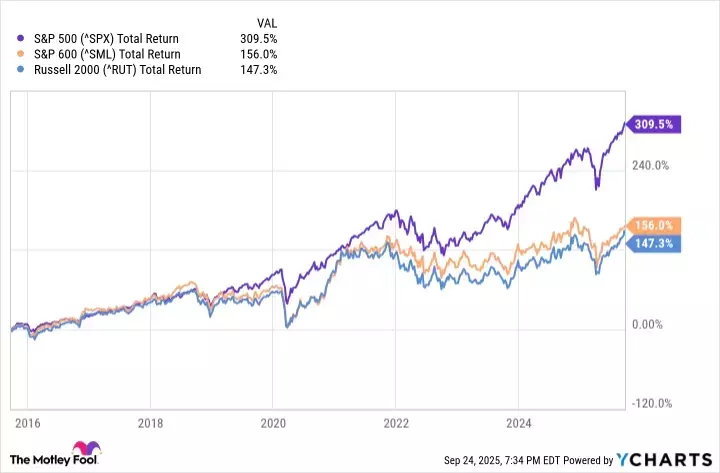
For an extended period, large-cap stocks have overshadowed small-cap performance, largely fueled by advancements in artificial intelligence. This trend predates the public emergence of OpenAI's ChatGPT in late 2022, marking over fifteen years of large-cap market dominance. This duration exceeds the historical average cycle of large-cap leadership, signaling a potential reversal. Analysts suggest that a resumption of monetary policy easing and a recovery in corporate profits could act as significant tailwinds for small caps.
The Valuation Discrepancy: A Compelling Opportunity
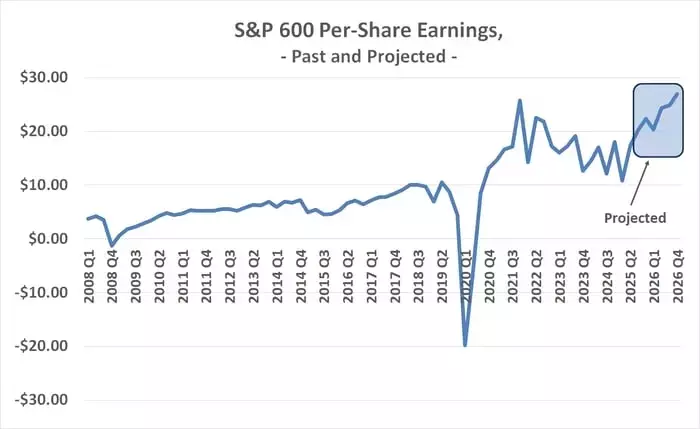
Despite recent rekindled earnings growth, small caps are currently undervalued. The S&P 600's forward-looking price-to-earnings ratio (P/E) of 15.7 is below its long-term average, in stark contrast to the S&P 500's P/E of 22.6, which is well above its historical norm. This valuation gap suggests that a market rotation from expensive large caps to more reasonably priced small caps is increasingly likely. The trigger for such a shift could be as simple as investors recognizing these underlying valuation differences.
Weighing Risks and Rewards: The Prudent Path to Small-Cap Exposure
While predictions of a small-cap resurgence have been made before without immediate fruition, the current economic climate presents a unique confluence of factors. The deceleration of growth among leading AI companies, coupled with anticipated interest rate reductions, could finally compel investors to acknowledge the favorable conditions for small caps. This potential economic growth cycle, which deviates from a traditional recessionary pattern, further strengthens the case for diversification. With small caps reporting their first quarterly earnings growth since Q3 2022 and projections for continued improvement through 2026, incorporating small-cap exposure into a diversified portfolio now presents a strategy with more upside potential than risk. This approach aims to capture additional returns from the market's natural long-term growth without abandoning the stability offered by S&P 500 index funds.
