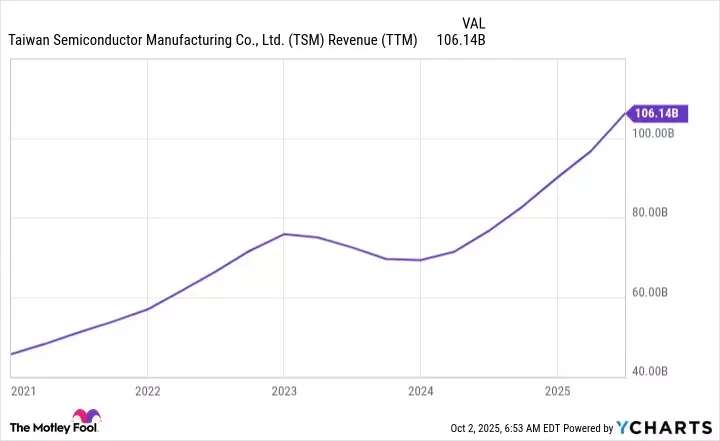
Taiwan Semiconductor (TSM) continues to be a pivotal player in the global technology landscape. This analysis delves into the core factors driving its ongoing success and highlights why it remains an attractive prospect for investors.
Unveiling the Future: TSMC's Strategic Growth Pillars
Unprecedented Surge in Chip Demand
Taiwan Semiconductor, a crucial manufacturing partner for leading technology firms such as Nvidia, stands to gain immensely from the escalating global demand for advanced chips. As Nvidia's Q2 earnings call projected, data center capital expenditures are expected to skyrocket from $600 billion in 2025 to an astounding $3 trillion to $4 trillion by 2030. This exponential growth translates directly into increased business for TSMC, given its central role in chip production. Beyond data centers, emerging technologies like autonomous vehicles, quantum computing, and humanoid robotics are also heavily reliant on sophisticated semiconductors, further solidifying TSMC's market position. Investing in TSMC is essentially a strategic bet on the pervasive and expanding need for advanced chip technology, a prediction that appears increasingly undeniable.
Strategic Expansion and U.S. Facility Investments
TSMC's expansion beyond its home base, particularly its substantial investments in U.S. manufacturing facilities, is a strategic move that offers significant benefits. While some may attribute this to U.S. tariff policies, this global diversification actively mitigates a key geopolitical risk: the potential for a mainland China takeover impacting its operations. By establishing production capabilities in various regions, TSMC enhances its operational resilience. The company has already committed $165 billion to new chip facilities in the U.S., with potential for further expansion if U.S. demand continues to outstrip capacity. Reports indicate that TSMC's existing U.S. facility has already secured chip orders through 2027, underscoring the robust demand for locally produced semiconductors. This increased U.S. presence benefits both American enterprises and TSMC, making it a compelling investment choice.
Relentless Commitment to Innovation
A cornerstone of Taiwan Semiconductor's dominance is its unwavering dedication to continuous improvement and technological innovation. As the world's leading chip foundry, TSMC consistently pushes the boundaries of semiconductor technology. Even with its current leadership in 3-nanometer (nm) chip nodes, the company is actively developing even more advanced solutions. This year, TSMC is set to introduce its 2nm chip, which promises a remarkable 25% to 30% reduction in power consumption compared to its 3nm predecessor when operating at comparable speeds. This energy efficiency is particularly critical given the growing concerns about data center energy usage. Looking ahead, TSMC plans to launch its A16 chip node next year, offering an additional 15% to 20% power consumption improvement over the 2nm node. This relentless pursuit of cutting-edge technology ensures that TSMC remains the preferred partner for advanced chip manufacturing. This commitment to innovation also translates into higher revenue and profits, as more advanced chips command premium pricing, making TSMC an attractive long-term investment.
