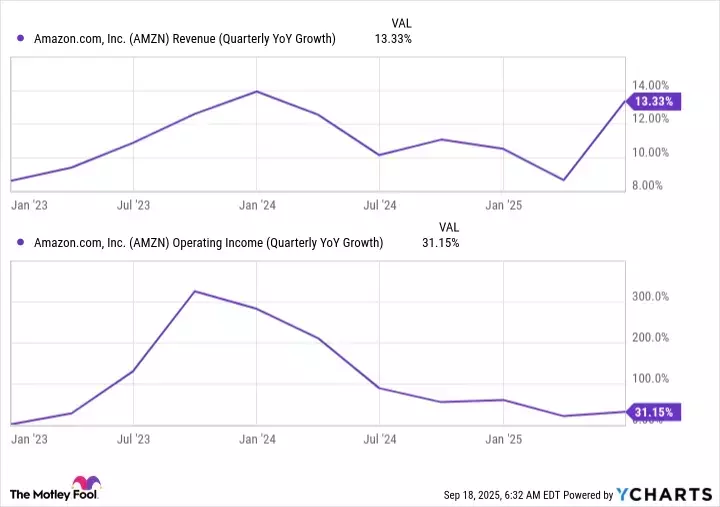

Amazon, a dominant force in the global market, is strategically positioning itself for substantial future expansion, with analysts forecasting a potential valuation of $5 trillion by the close of 2030. This impressive growth is not merely an extension of its past successes but is fundamentally underpinned by the dynamic performance and increasing profitability of its cloud computing arm, Amazon Web Services (AWS), and its rapidly expanding advertising business. These key divisions are identified as the primary catalysts for the company's accelerating operating profits, signaling a robust and attractive outlook for investors.
Amazon's Strategic Pillars: AWS and Advertising
While many associate Amazon primarily with its vast e-commerce platform, the company's true engines of profitability and future growth lie in Amazon Web Services (AWS) and its rapidly expanding advertising division. These two segments are not only the fastest-growing within Amazon but also contribute the majority of its operating profits. AWS, Amazon's cloud computing arm, capitalizes on the increasing demand for outsourced computing power. Companies are increasingly opting to rent computing resources from providers like AWS, rather than investing in and maintaining expensive server infrastructure themselves. This trend offers businesses scalability and flexibility, allowing them to adjust their computing needs seamlessly. The cloud computing market is experiencing a significant surge, driven by the ongoing migration of enterprise workloads to the cloud and the immense computational demands of artificial intelligence. Projections indicate a substantial increase in the global cloud computing market, suggesting sustained growth for AWS. Parallel to this, Amazon's advertising services have emerged as a star performer. Leveraging its position as a primary shopping destination, Amazon provides an incredibly effective advertising platform where businesses can target customers actively seeking to make purchases. This direct path to conversion makes Amazon's advertising space highly valuable. Both AWS and the advertising division consistently demonstrate high operating margins, comparable to leading advertising-focused companies, and are expected to continue their robust growth trajectories.
Amazon's journey towards a $5 trillion valuation is largely dependent on the continued exceptional performance of AWS and its advertising services. These divisions are expected to sustain their rapid growth, outpacing the overall revenue growth of the company and consequently driving a disproportionate increase in operating profits. The fundamental shifts towards cloud-based solutions and the ever-growing significance of digital advertising create powerful tailwinds that are unlikely to dissipate by 2030. Cloud computing benefits from the continuous migration of business operations to the cloud, as organizations seek to reduce infrastructure costs and enhance operational agility. Furthermore, the burgeoning field of artificial intelligence heavily relies on advanced computing capabilities, making cloud services like AWS indispensable for many enterprises. Similarly, Amazon's advertising arm thrives on its unique ability to connect advertisers directly with consumers who are in a purchasing mindset, offering a highly effective channel for product promotion and sales. The high profitability of these segments, coupled with their strong market positions and favorable industry trends, ensures that Amazon's operating income will continue to expand at a significant rate. Even with conservative growth estimates for operating profits and a slight compression in its valuation multiple, Amazon's path to a $5 trillion market capitalization by the end of the decade appears well within reach, reinforcing its status as a compelling long-term investment.
The Trajectory Towards a $5 Trillion Market Cap
Amazon's strategic path to achieving a $5 trillion market capitalization by 2030 is intricately linked to the sustained, outsized growth of its Amazon Web Services (AWS) and advertising segments. These divisions are not only expanding at a faster pace than the company's overall revenue but are also significantly boosting its operating profits. This trend indicates a shift in Amazon's financial narrative from a pure revenue growth story to one driven by burgeoning operating income. The prevailing market conditions, characterized by a continuous migration to cloud computing and the escalating demand for artificial intelligence capabilities, provide strong, enduring tailwinds for AWS. Businesses are increasingly adopting cloud solutions for their flexibility, scalability, and cost efficiency, and AI's intense computational requirements further solidify the necessity of advanced cloud infrastructure. Concurrently, Amazon's advertising platform leverages its vast e-commerce ecosystem, offering an unparalleled environment for advertisers to reach engaged customers with a high intent to purchase. This unique advantage translates into premium advertising rates and robust growth for the segment. Both AWS and advertising services demonstrate high operating margins, contributing significantly to Amazon's bottom line.
For Amazon to realize its $5 trillion valuation goal, it is crucial for AWS and advertising services to maintain their impressive growth trajectories. These two divisions are the primary catalysts for the company's expanding operating profits, which are projected to grow at a rate of 20% to 30% annually over the next five years. This sustained growth in operating income, even with conservative assumptions about valuation multiples, positions Amazon favorably to achieve its ambitious market capitalization target. The structural shifts in technology and consumer behavior that fuel these segments are not transient; rather, they represent fundamental changes that will continue to drive demand well beyond 2030. The increasing reliance on cloud infrastructure for everything from data storage to complex AI model training ensures a steady revenue stream for AWS. Similarly, as digital commerce continues to evolve, targeted advertising on platforms where consumers are actively seeking products will remain highly effective and sought after by businesses. The company's ability to consistently convert these growth opportunities into tangible operating profit gains will be key. Should Amazon manage to grow its operating profits at the lower end of the projected range (20%) and even if its valuation multiple contracts slightly, the calculations still point towards a market value exceeding $5 trillion by 2030. This conservative yet optimistic outlook underscores Amazon's robust investment appeal and its potential to continue delivering strong returns.
