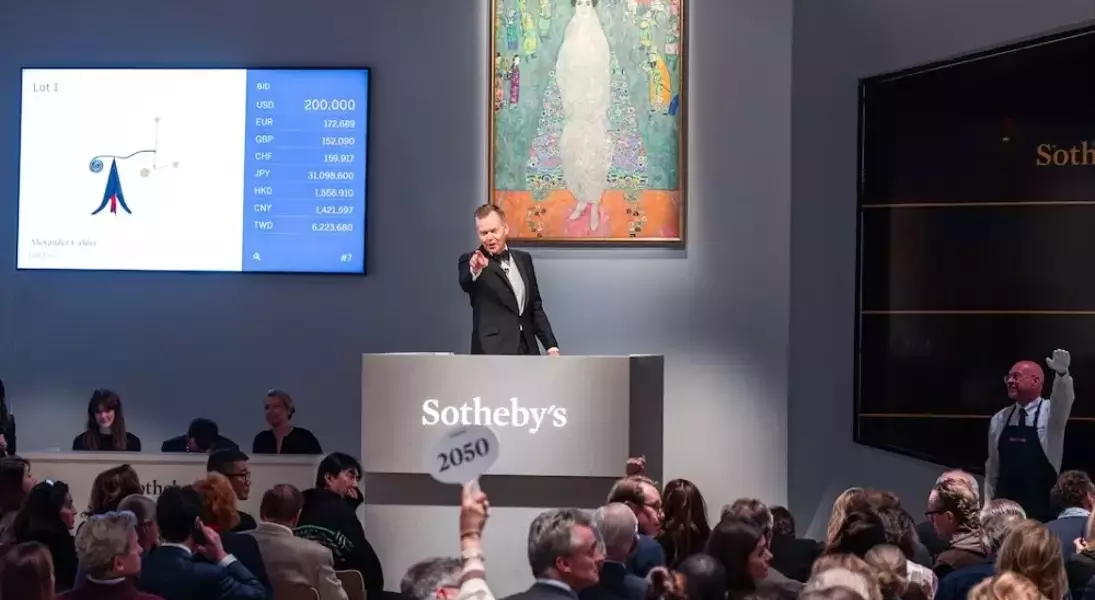
The recent marquee art auctions in New York have painted a clear picture of a bifurcated art market: while the top tier is experiencing a robust resurgence, the middle and lower segments continue to struggle. High-value works by established masters are commanding impressive prices, often setting new records, but the broader market for emerging and mid-career artists remains sluggish. This trend highlights a 'flight to quality' among collectors, who are prioritizing historically significant and low-risk investments.
November Art Auction Analysis: High-End Triumphs Amidst Market Nuances
In November 2025, the global art market witnessed significant activity during the marquee auction sales held in New York. Christie's 20th/21st Century sale on a Monday evening generated an impressive $690 million. However, this figure fell slightly below its pre-sale high estimate of $731.5 million, tempering initial enthusiasm about a market-wide recovery after a challenging two-year period.
The following Tuesday proved to be a pivotal day for Sotheby's, which hosted a successful double-header event. These sales, encompassing works from the esteemed collection of the late cosmetics heir Leonard Lauder and a "The Now & Contemporary" sale, collectively achieved a staggering $706 million. This significantly surpassed their combined pre-sale high estimate of $680.7 million. Helena Newman, Sotheby's Europe chairman, emphatically declared that the house had "made history" at the iconic Breuer building, attributing much of this success to several record-breaking sales.
A standout moment was the sale of Gustav Klimt's Portrait of Elisabeth Lederer (1914–16) for an astounding $236.4 million. This not only marked the highest price ever paid for a modern art piece at auction but also ranked as the second-highest price for any artwork sold at auction, surpassed only by Leonardo da Vinci's Salvator Mundi in 2017. By the close of the evening, three Klimt masterpieces alone had contributed a colossal $400 million to Sotheby's coffers, underscoring the enduring appeal and financial power of these iconic works.
The Lauder collection, in particular, contributed $527.5 million to the evening's total. Meanwhile, the "The Now & Contemporary" sale fetched $178.5 million, with Jean-Michel Basquiat's painting leading this segment at $48.3 million. Vincent van Gogh's The Sower (1888) also set a new auction record for a pen-and-ink work by the artist, selling for $11.2 million. However, Maurizio Cattelan's provocative golden toilet sculpture, America (2016), garnered only a single bid and sold for $12.1 million, a sum equivalent to its melt value, failing to ignite the anticipated bidding frenzy despite its previous publicity.
Christie's sales on Monday were characterized by intense bidding wars. Mark Rothko's No. 31 (Yellow Stripe) (1958) achieved $62.2 million after 20 bids, Henri Matisse's Figure et bouquet (Tête ocre) (1937) reached $32.3 million following nearly 30 bids, and Marc Chagall's Le songe du Roi David (1966) secured $26.5 million after 32 bids. Alex Rotter, Christie's global president, expressed a sense of a rising tide in the market, noting that the collections offered a substantial depth of quality.
Jussi Pylkkänen, founder of Art Pylkkänen, reiterated that the results signal the robust recovery of the high-end art market, particularly for works exceeding $10 million. He observed a clear shift towards classic modernists such as Klimt, Matisse, and Rothko, with contemporary art showing signs of struggle. Art market economist Clare McAndrew supported this view, emphasizing that high-quality, scarce works by artists with established historical significance will always command strong prices, especially given the increasing wealth controlled by billionaires globally.
Amanda Lo Iacono, founder of CounterA, affirmed that dedicated buyers remain active in the market. Nevertheless, she cautioned against viewing evening sale results as a complete indicator of market health, stressing the importance of considering the wider ecosystem, including day sales, which provide a clearer picture of broader market functionality. She concluded that while the market is showing renewed appetite, strategic adjustments are needed to sustain this momentum.
The November auction season in New York underscores a crucial insight into the contemporary art market: while iconic works by established masters continue to command astronomical prices and attract fervent bidding, the broader market faces an uneven recovery. This disparity highlights a discernible shift in collector behavior, favoring 'blue-chip' investments with proven historical value and lower risk, particularly in uncertain economic climates. For emerging artists and the mid-market segment, this suggests a continued need for innovation and strategic positioning to capture collector attention and investment. The pronounced success at the top tier, exemplified by record-breaking sales, may inspire confidence but also serves as a stark reminder of the challenges faced by other market sectors. This 'flight to quality' paradigm calls for a re-evaluation of market strategies for galleries, artists, and collectors operating outside the uppermost echelons of the art world.