
This analysis contrasts the investment merits of two prominent tech companies, ASML and Palantir, both significant players in the burgeoning artificial intelligence sector. While Palantir has witnessed remarkable stock appreciation driven by the AI surge, its current market valuation appears considerably stretched. In contrast, ASML, with its undisputed technological leadership in extreme ultraviolet (EUV) lithography, presents a compelling investment case, offering a more sensible valuation alongside strong future growth prospects.
Detailed Investment Outlook: ASML vs. Palantir
In the dynamic landscape of AI and technology investments, two companies frequently draw investor attention: Palantir Technologies and ASML. Palantir, a data analytics firm, has seen its stock soar by approximately 2,600% since the commencement of the AI race in 2023, propelling its market capitalization to an impressive $410 billion, securing its position among the world's top 25 most valuable companies. This rapid ascent underscores its significant impact within the AI investment sphere.
However, an alternative perspective suggests that ASML, a Dutch multinational specializing in the development and manufacturing of photolithography systems, might offer a more robust investment opportunity for the future. ASML, currently valued at around $400 billion, is the sole provider of advanced extreme ultraviolet (EUV) lithography machines globally. These highly specialized machines are indispensable for fabricating the most cutting-edge microchips, with current technology enabling features as small as 3 nanometers (nm) and 2nm variants on the horizon. To put this into context, a human hair measures between 50,000 to 100,000 nm, and a red blood cell is 7,000 nm, making the precision of ASML's technology truly extraordinary.
ASML's exclusive control over this critical technology grants it a formidable technological monopoly. The immense cost and time required to replicate such advanced capabilities deter potential competitors, establishing a significant competitive moat around its proprietary innovations. This unique market position is a rarity in competitive industries, making ASML an attractive proposition for astute investors. As the demand for AI chips continues its upward trajectory, the necessity for increased production capacity directly translates into higher demand for ASML's machinery, solidifying its pivotal role in the semiconductor ecosystem.
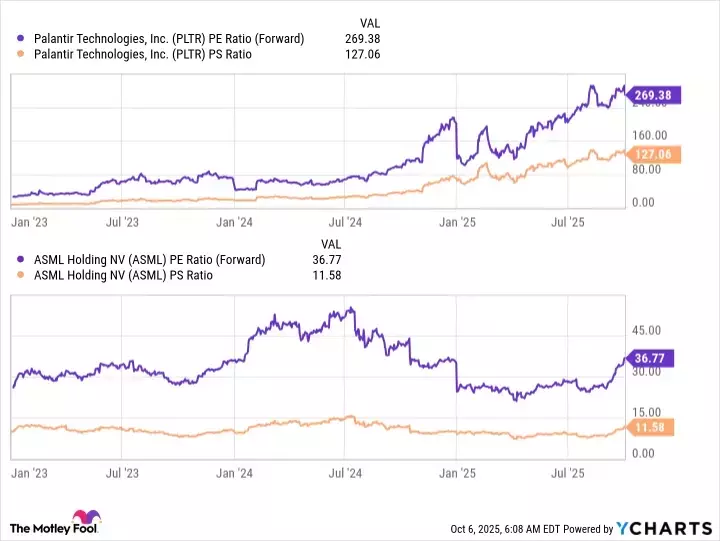
Conversely, Palantir's impressive growth comes with a substantial valuation premium. The company's stock trades at an astonishing 127 times sales and 269 times forward earnings. Even under highly optimistic scenarios, such as a sustained 50% annual revenue growth rate and a 35% profit margin through 2030, Palantir's stock would still maintain a valuation significantly higher than ASML's current pricing. This indicates that Palantir's future growth is already heavily factored into its present stock price, potentially limiting its upside.
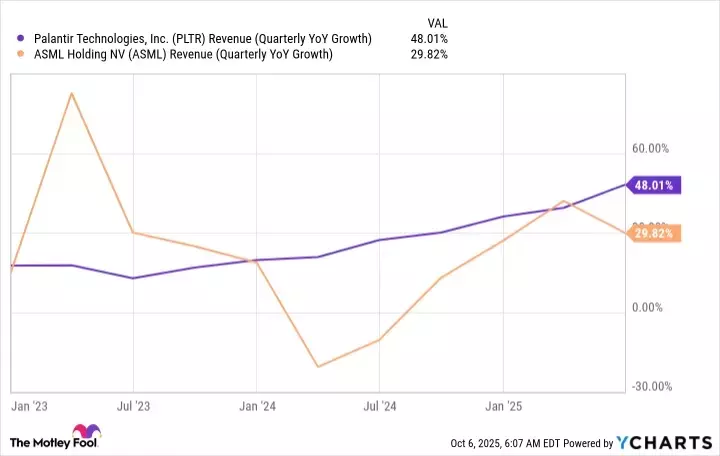
In contrast, ASML trades at a more reasonable 37 times forward earnings and 12 times sales. Management forecasts its revenue to grow from 32 billion euros over the last 12 months to between 44 billion and 60 billion euros by 2030. This substantial, yet realistically priced, growth trajectory suggests that ASML's stock is poised for steady appreciation over the long term, potentially outperforming even the most dynamic AI-driven stocks like Palantir.
From an investment standpoint, ASML's technological indispensability, combined with its more conservative valuation and strong growth outlook, positions it as a superior long-term investment. While Palantir offers thrilling growth, the price of entry carries considerable risk, whereas ASML provides a foundationally critical role in an expanding industry with a more grounded financial profile.
This comparison highlights a critical investment lesson: dazzling growth rates alone do not guarantee superior returns. A company's market position, competitive advantages, and, crucially, its valuation relative to its growth prospects are equally, if not more, important. ASML exemplifies a strong, stable investment rooted in technological supremacy, offering a potentially more secure and rewarding path for long-term investors in the evolving tech landscape.
