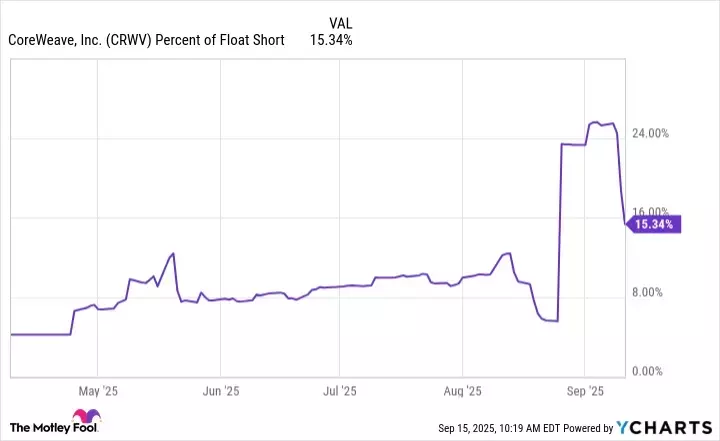

CoreWeave, a company that recently entered the public market and quickly became a notable player in the artificial intelligence sector, is currently navigating a period of intense scrutiny and financial instability. Despite its initial success, marked by a significant valuation surge, the company's stock has faced a considerable downturn. This decline has not only affected its market standing but also cast a shadow over a pivotal acquisition intended to bolster its operational efficiency and financial health. The core issue lies in its substantial losses and high short interest, signaling a lack of confidence among many investors regarding its future trajectory and ability to achieve profitability.
The situation is further complicated by internal and external pressures. The expiration of the post-IPO lockup period saw insiders offloading shares, contributing to the downward spiral. More critically, the proposed all-stock deal to acquire Core Scientific, a strategic move designed to mitigate future lease obligations and enhance its data center capabilities, is now in jeopardy. The sharp depreciation in CoreWeave's stock value has led to strong opposition from key stakeholders of Core Scientific, who argue that the current valuation undervalues their company. This precarious position highlights the challenges CoreWeave faces in convincing the market and its partners of its long-term potential amidst mounting financial concerns and a skeptical investor base.
CoreWeave's Market Performance and Investor Concerns
CoreWeave, an AI stock that debuted on the public market this year, saw its valuation initially triple but has since experienced a 26% drop in the past three months. This decline is partly attributed to insiders selling shares after the post-IPO lockup expired, exacerbating worries about the company's financial health. The stock is also heavily shorted, indicating significant investor skepticism about its future prospects and potential for sustained success. This high short interest suggests a prevailing bearish sentiment, with many investors betting against the company's ability to deliver long-term value, leading to increased volatility and rapid price movements as short-sellers either cover positions or intensify their bearish bets.
Since its public offering earlier this year, CoreWeave has been touted as a hot artificial intelligence (AI) stock, largely due to its strategic partnership with chipmaker Nvidia. This collaboration initially positioned CoreWeave as a seemingly secure investment within the burgeoning AI landscape, reflected in its tripling valuation post-IPO. However, the enthusiasm has waned considerably, with its stock price plummeting by approximately 26% over the last quarter. A primary factor contributing to this downturn is the expiration of the post-IPO lockup period, which prompted insiders to sell their shares, signaling a potential lack of confidence from within. This selling pressure has intensified existing concerns, especially regarding a crucial acquisition intended to improve CoreWeave's financial metrics. Furthermore, the company faces substantial short interest, a clear indicator that a significant portion of the market harbors doubts about its growth trajectory and long-term viability. This persistent bearish sentiment translates into heightened stock volatility, where even minor market shifts can trigger rapid price fluctuations, as short-sellers either mitigate their risks or double down on their negative outlook.
Acquisition Challenges and Financial Viability
CoreWeave's falling stock price has put its $9 billion all-stock acquisition of Core Scientific at risk. This deal was considered a strategic necessity for CoreWeave to improve its financial standing, as it aimed to eliminate up to $10 billion in future lease obligations and boost efficiency. However, the significant decline in CoreWeave's valuation, from $160 to $116 per share, has prompted Core Scientific's largest shareholder, Two Seas Capital LP, to oppose the deal, citing an undervaluation. This opposition, coupled with CoreWeave's substantial $1.1 billion in losses over the last 12 months despite $3.5 billion in sales, casts serious doubt on the acquisition's completion and CoreWeave's path to profitability.
The current financial landscape for CoreWeave is fraught with challenges, particularly concerning its ambitious plan to acquire Core Scientific. This all-stock transaction, originally valued at $9 billion, was envisioned as a transformative move for CoreWeave. By integrating Core Scientific's data center operations, CoreWeave aimed to significantly reduce its future lease commitments—potentially by up to $10 billion—and achieve greater operational efficiency. Yet, the sharp depreciation of CoreWeave's stock has jeopardized this crucial acquisition. The stock's value has fallen from approximately $160 to $116 per share since the deal was announced, leading to strong opposition from Core Scientific's largest shareholder, Two Seas Capital LP, who contends that the revised terms now undervalue their company. This impasse is further complicated by CoreWeave's precarious financial state, evidenced by a staggering $1.1 billion in losses over the past year, despite generating $3.5 billion in sales. The potential failure of this acquisition, combined with its ongoing inability to stem losses, raises fundamental questions about CoreWeave's business model sustainability and its capacity to achieve long-term profitability, making it a highly speculative investment even at its reduced stock price.
