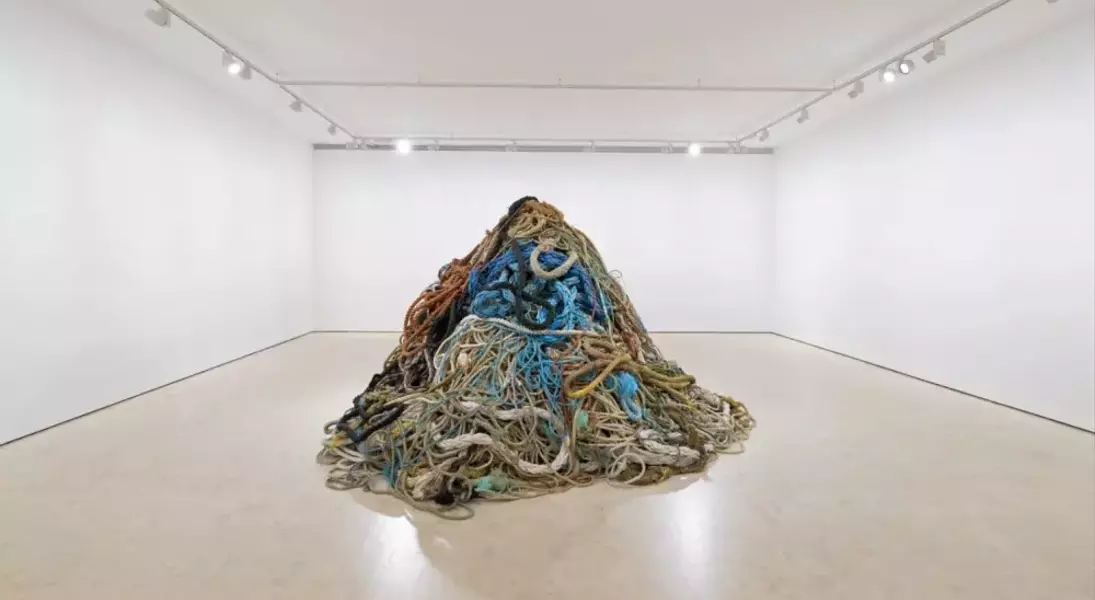
Artist David Shrigley's recent conceptual art piece, an expansive heap of used rope, has premiered at the Stephen Friedman Gallery in London, inviting viewers to ponder the intrinsic value of artistic creations. This installation, provocatively priced at £1 million, positions itself within a lineage of 'readymade' artworks that challenge conventional notions of art and commerce.
Questioning Value: When Discarded Rope Becomes a Million-Dollar Masterpiece
The Unconventional Art of Valuing the Mundane: Shrigley's Latest Statement
Following in the footsteps of artworks that transform everyday objects into profound statements, such as an inverted urinal or a banana taped to a wall, David Shrigley now introduces a massive collection of aged ropes. This installation, titled "David Shrigley: Exhibition of Old Rope," opened its doors to the public in London, igniting discussions around the perceived worth of art. Shrigley, renowned for his minimalist paintings often coupled with ironic captions, has once again delivered a piece that is as direct as it is thought-provoking. The exhibition features ten tons of discarded rope, meticulously gathered and arranged on the gallery floor. This particular artwork carries a price tag of £1 million, significantly less than the $6.2 million once fetched by Maurizio Cattelan's duct-taped banana, yet equally effective in stirring conversation about artistic valuation.
The Journey of Discarded Rope: From Utility to Artistic Expression
Shrigley dedicated several months to sourcing these neglected ropes from various locations across the United Kingdom, many of which were originally slated for disposal. The collection encompasses a wide array of ropes, varying from substantial mooring lines once used by cruise ships to slender cords from marker buoys, fishing traps, and longlines. Furthermore, some segments were repurposed from climbing facilities, arborists, offshore wind farms, scaffolding companies, and window cleaning services, as detailed in the exhibition's descriptive text.
Exploring Art's Worth: Shrigley's Deliberate Provocation
When questioned about the underlying message of his work, Shrigley articulated that the project originated from the common saying "money for old rope," implying something of little to no value. He noted the environmental challenge of recycling such materials, highlighting the abundance of discarded rope. This observation prompted him to conceive an exhibition that literalized the idiom, presenting the old rope as a legitimate piece of art available for a million pounds. Shrigley's intention was to delve into how individuals assign value to art, using the idiom as a catalyst for this exploration. He posits that the £1 million price is justified, attributing it partly to the conceptual depth and partly to the sheer volume of material involved.
A Signature Deadpan Commentary on Artistic Conventions
This installation exemplifies Shrigley's characteristic dry wit. The physical presence of the piled rope mirrors the aesthetic of his two-dimensional works, easily imagined as a simple sketch accompanied by the phrase "Money for old rope." The exhibition is anticipated to elicit varied responses, much like many conceptual art forms. However, its capacity to shock may be mitigated by the art world's increasing familiarity with such unconventional presentations. The concept of "readymades," introduced by Marcel Duchamp over a century ago, has been explored by numerous artists, including Man Ray, Joseph Beuys, and Pablo Picasso, long before Tracey Emin's "My Bed" garnered widespread attention in 1998.
Artistic Commentary Meets Economic Realities: A Gallery's Dilemma
Eddy Frankel, an art critic for The Guardian, offered a poignant observation that merits reflection. He pointed out the awkwardness of Shrigley's critical stance on art's value, especially when displayed in a gallery that has faced significant financial struggles, as Stephen Friedman Gallery reported substantial losses earlier in the year. Frankel suggested that Shrigley's work implicitly asks, "You'd buy any old rubbish, wouldn't you?" yet the irony lies in the gallery's difficulty in selling even seemingly ordinary items. The question remains whether anyone will ultimately acquire this £1 million collection of "old rubbish." Nevertheless, the timing is opportune, with Maurizio Cattelan's 18-karat gold toilet, weighing 100 kg, set to appear at auction in New York this month, further testing the public's appetite for and valuation of conceptual art.
