
Advanced Micro Devices (AMD) faces significant challenges in the rapidly evolving landscape of AI computing. While Nvidia currently dominates this crucial sector, AMD's diversified business structure and strategic focus on various computing segments define its unique market position. This analysis evaluates AMD's competitive standing, its current financial metrics, and its potential trajectory in the coming years, particularly in contrast to its primary rival. Despite its broad portfolio, including data center, client, and gaming divisions, AMD grapples with an expensive stock valuation and a growth rate that may not fully justify its premium. Investors are left to weigh AMD's efforts to enhance profit margins against the overwhelming influence of industry leaders and the inherent risks associated with market fluctuations.
AMD's path forward is characterized by a multi-faceted approach, aiming to leverage its diverse product offerings while navigating intense competition. The company's performance in the data center segment, a critical area for AI innovation, shows a notable disparity when compared to Nvidia's accelerated growth. Moreover, the emergence of AI hyperscalers developing proprietary chips in collaboration with other industry players further complicates AMD's competitive environment. This article provides an in-depth examination of these factors, offering insights into AMD's prospects for achieving sustainable growth and investor returns by the end of the decade, highlighting both its inherent strengths and the substantial hurdles it must overcome.
AMD's Position in the Competitive AI Hardware Landscape
Advanced Micro Devices (AMD) finds itself in a challenging position as a secondary player in the burgeoning AI computing hardware market, a space largely dominated by its competitor, Nvidia. Unlike Nvidia, which maintains a concentrated focus on high-powered graphics processing units (GPUs) essential for AI, AMD's business is notably more diversified. This diversification spans across data center, client, and gaming, as well as embedded processor divisions. While this breadth might offer stability, it also means AMD is not singularly dedicated to the AI computing segment, potentially limiting its ability to directly challenge Nvidia's leadership. The company's current role often relegates it to being an alternative option for customers seeking leverage against Nvidia's pricing strategies, rather than a primary innovator in the most cutting-edge AI technologies.
The competitive pressure on AMD is intensifying, not only from Nvidia but also from new market entrants. AI hyperscalers are increasingly collaborating with companies like Broadcom to design their own specialized chips, presenting another formidable challenge. These internal development efforts by major clients could dilute AMD's market share and revenue opportunities in the future. Furthermore, a ban on selling computing hardware to certain regions, such as China, has disproportionately impacted AMD's data center revenue growth compared to Nvidia's impressive gains. For instance, AMD's data center revenue saw a 14% year-over-year increase in the second quarter, significantly lagging behind Nvidia's 56% growth during the same period. This stark difference underscores the difficulty AMD faces in catching up, particularly as existing AI infrastructure is heavily built on Nvidia's architecture, making switching costs prohibitive for many customers. Consequently, AMD is firmly entrenched in second place, with its other divisions, such as embedded, client, and gaming, showing limited long-term growth potential, typically not exceeding 10% annually, thus offering only market-average returns.
Evaluating AMD's Valuation and Long-Term Investment Prospects
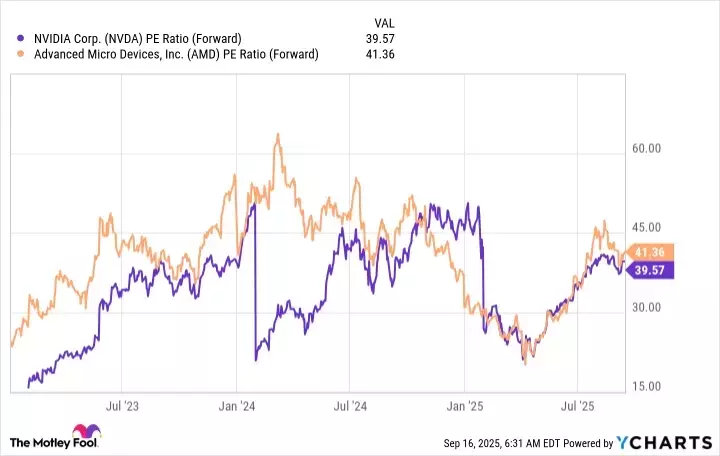
Despite being positioned as a secondary contender in the AI hardware market, Advanced Micro Devices (AMD) currently trades at a valuation that is surprisingly high, even exceeding that of its dominant rival, Nvidia. AMD's forward earnings multiple of 41 times suggests a premium valuation that many analysts believe is not entirely justified by its projected growth trajectory. While Wall Street analysts anticipate revenue growth of 28% in 2025 and 22% in 2026, there are numerous other companies within the tech sector that are expected to achieve similar or even higher growth rates without commanding such a steep price tag. This elevated valuation raises questions about the stock's attractiveness for long-term investors, especially given the fierce competition and the company's relatively less aggressive focus on the high-growth AI segment compared to Nvidia.
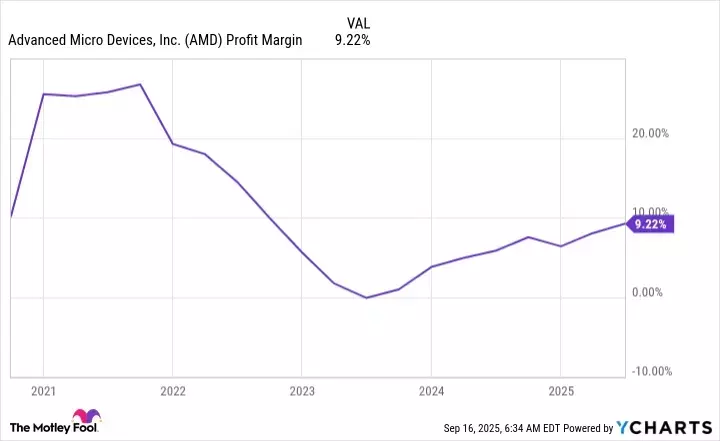
However, AMD's investment appeal is not solely dependent on its revenue growth. The company has demonstrated a consistent effort to enhance its profit margins, a critical factor for long-term financial health. Should AMD succeed in boosting its margins to approximately 15% by 2030, and if it were to trade at a more modest valuation of 30 times forward earnings while sustaining a 20% growth pace, its stock could potentially reach around $225 per share. This scenario would represent a moderate upside of about 40% from its current price. Nevertheless, this projected return is considered less compelling when compared to alternative investment opportunities that offer higher growth potential or more favorable valuations within the industry. Moreover, any downturn in the broader AI market could significantly impact AMD's stock performance, potentially leading to substantial losses, even if these are less severe than those experienced by more AI-centric firms like Nvidia. Therefore, investors may find more advantageous opportunities by exploring other stocks that exhibit stronger growth fundamentals or more attractive valuations in the current market environment.
