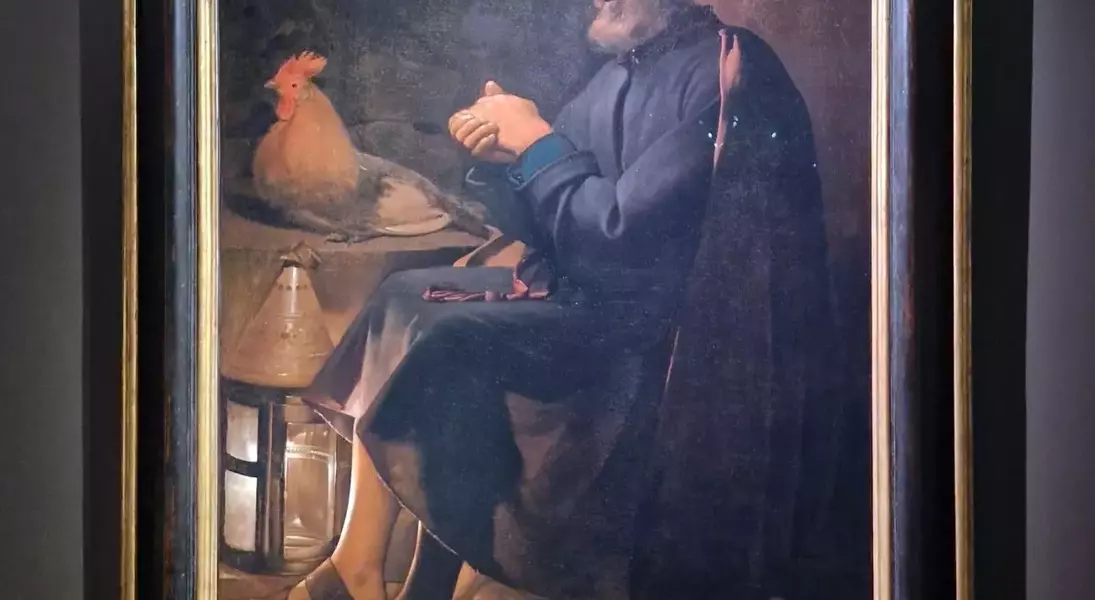
The Musée Jacquemart-André's latest exhibition, "From Shadow to Light," offers a profound exploration of Georges de la Tour, a master of French Baroque painting. This retrospective, the first in France since 1997, delves into de la Tour's distinctive artistic approach, particularly his adaptation of Caravaggio's dramatic chiaroscuro. The exhibition reveals how de la Tour transformed ordinary genre scenes into deeply intimate and spiritual narratives, utilizing singular light sources and a compressed pictorial space to draw viewers into the emotional core of his subjects. Despite the inherent challenges of displaying monumental works within the museum's historic, compact setting, the curation effectively underscores the artist's unique style, characterized by harsh linearity and flatter modeling, which sets him apart from his Caravaggesque contemporaries.
De la Tour's genius lies in his ability to imbue everyday life and biblical stories with a compelling sense of immediacy and emotional depth. His paintings, often depicting isolated figures illuminated by a single candle flame, create a profound connection between the viewer and the subject. The exhibition's strength is its successful gathering of works from an impressive range of international collections, demonstrating the global appreciation for this long-overlooked artist. The curatorial choice to let the art speak for itself, even with French-only captions, is a testament to the powerful visual storytelling inherent in de la Tour's oeuvre, making this a significant cultural event for art enthusiasts.
The Unique Application of Chiaroscuro in De La Tour's Art
Georges de la Tour's exhibition at the Musée Jacquemart-André, "From Shadow to Light," emphasizes his innovative use of chiaroscuro, a technique he adapted from Caravaggio. Unlike Caravaggio, who employed dramatic contrasts of light and shadow on expansive canvases with grand gestures, de la Tour applied this technique to more commonplace scenes. His compositions frequently feature isolated figures clustered around a singular light source, often a candle, which intensifies the emotional and spiritual depth of the moment. This approach creates an intimate and introspective atmosphere, drawing the viewer into a closely confined pictorial space. The exhibition highlights how this unique stylistic choice allowed de la Tour to infuse his genre paintings and religious narratives with a distinct sense of human connection and profound emotion, making the distant resonate with immediate impact for the audience.
De la Tour's reinterpretation of chiaroscuro is a central theme, distinguishing his work from his contemporaries. While Caravaggio’s art features a rounded, softer painterly style even amidst dramatic narratives, de la Tour opts for a more rigid linearity and a flatter modeling technique. This results in less gradual tonal transitions and a shallower sense of space within his paintings. A prime example is his 'Job Mocked by his Wife,' where the figures are positioned very close to the picture plane, almost pressing against the viewer's space. This, combined with the single, low-burning candle as the light source, generates an intense, almost claustrophobic intimacy. This artistic choice serves to render often-remote biblical narratives with remarkable directness and emotional accessibility, fostering a deep sense of relatability for those viewing his work, thereby transforming the ordinary into the extraordinary and the sacred into the immediately present.
Exhibition Challenges and Curatorial Triumphs in Paris
The Musée Jacquemart-André’s current Georges de la Tour retrospective, "From Shadow to Light," navigates notable exhibition challenges within its unique architectural setting. Housed in a former private residence, the museum's galleries are inherently compact, a stark contrast to the grand scale typically associated with displaying Baroque masters. This physical constraint meant that a more expansive presentation, similar to those for Caravaggio or Artemisia Gentileschi, was not feasible. Despite these spatial limitations, the exhibition triumphs by showcasing a remarkable assembly of de la Tour's works, sourced from diverse international collections ranging from Tokyo to Washington. This global convergence of his paintings is a significant curatorial achievement, highlighting the enduring appeal and scholarly importance of this often-overlooked French Baroque artist.
The physical constraints of the Musée Jacquemart-André's galleries, likened to the intimate setting of the Wallace Collection, present a unique viewing experience that, while at times crowded, inadvertently mirrors de la Tour’s artistic tendency to bring his subjects into close proximity with the viewer. The density of the displays and the consistent, albeit moderate, lighting conditions, while not ideal for showcasing the full impact of de la Tour's tonal nuances, do not diminish the exhibition's overarching ambition. The curators, Gail Feigenbaum and Pierre Curie, deserve commendation for overcoming logistical hurdles, such as spatial and budgetary restrictions, to gather such a comprehensive collection. The exhibition's focus on de la Tour's incorporation of Caravaggesque chiaroscuro into austere genre compositions, and its successful demonstration through the sheer visual power of the paintings, renders the language barrier of French-only captions largely irrelevant. The sheer breadth of loans from various geographical locations underscores the exhibition's significance and its role in re-evaluating de la Tour's place in art history.