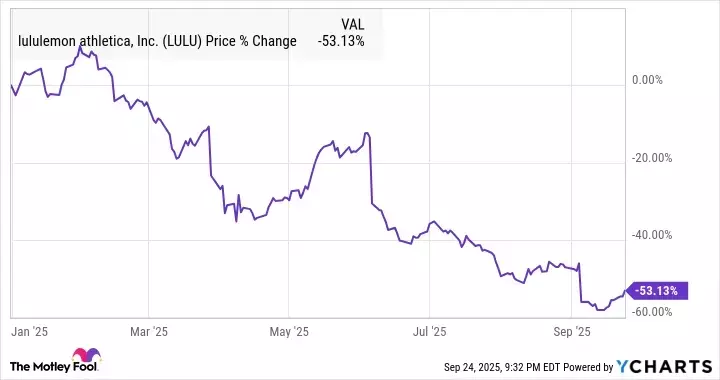

Lululemon Athletica has seen its stock plummet by more than 50% this year, a sharp contrast to its historical performance as a market leader. This downturn is largely attributed to a confluence of factors affecting its primary U.S. market, including a slowdown in consumer spending on non-essential items, an evolving fashion landscape that favors different workout apparel styles, and the company's own acknowledgment of needing to revitalize its product offerings. Furthermore, a recent change in de minimis tariff exemptions impacted its financial outlook. Despite these headwinds, the company is actively implementing strategies to overcome these challenges, such as accelerating product innovation and optimizing its supply chain. Concurrently, Lululemon is experiencing robust growth in international markets, particularly in China, underscoring the brand's continued global appeal. This divergence in market performance, coupled with a significantly reduced stock valuation, presents a compelling case for investors looking for long-term growth opportunities.
Historically, Lululemon has been a powerhouse in the stock market, largely credited with popularizing athleisure wear and making yoga pants a staple in everyday fashion. The company has skillfully maintained a premium brand image and strong pricing power, even when faced with aggressive competition from lower-priced alternatives. However, the current year has presented unprecedented challenges for the athletic apparel giant, leading to a substantial drop in its stock value. The most significant hurdles have emerged in its crucial U.S. market, where comparable sales have begun to decline. This decline is influenced by broader economic factors, such as consumers tightening their belts on discretionary purchases like clothing, and a notable shift in fashion preferences from form-fitting yoga pants to looser, baggier styles. Lululemon's management has also acknowledged internal missteps, admitting that their efforts to keep lounge and social wear styles innovative and current were insufficient.
Adding to these domestic challenges, Lululemon's second-quarter earnings report revealed a revised earnings guidance, primarily due to the expiration of the de minimis exemption. This exemption previously allowed importers like Lululemon to avoid tariffs on shipments valued at $800 or less, a policy the company utilized for e-commerce orders shipped from Canada to the U.S. The elimination of this advantage necessitates a restructuring of its supply chain to mitigate the impact of these new taxes. The stock's performance reflects these difficulties, with a 53% year-to-date decline, positioning it among the lowest performers in the S&P 500. From its peak in late 2023, the stock has fallen by a staggering 65%.
Despite the recent setbacks, many of Lululemon's current difficulties appear to be temporary or manageable. The macroeconomic pressures, such as a sluggish job market, inflation concerns, and tariff fears, are cyclical and expected to improve over time. Consumer discretionary spending, particularly in sectors like apparel and dining, tends to rebound as consumer confidence strengthens. The impact of the de minimis exemption's removal, while significant, is a one-off event that has already been factored into the company's updated guidance. Lululemon is actively adapting by reconfiguring its supply chain to bypass these tariffs, ensuring that this particular issue will not recur. Furthermore, the company is proactively addressing its inventory and style challenges by increasing the proportion of new styles from 23% to 35% by next spring. It is also streamlining its go-to-market process to react more quickly to fashion trends and ensure popular items remain in stock.
Crucially, Lululemon continues to demonstrate robust performance in international markets, particularly in China, which has become its second-largest market. Sales in China have surged by 17%, contributing significantly to a 25% increase in overall revenue. This success mirrors the growth trajectories of other prominent American brands like Nike and Starbucks in the Chinese market, known for its strong consumer demand for luxury and aspirational goods. Lululemon plans to capitalize on this momentum by opening at least 15 new stores in China next year, expanding its footprint in a region that still offers substantial growth opportunities. The strong international performance indicates that while the U.S. market faces hurdles, the overall growth story for Lululemon as a global brand remains compelling.
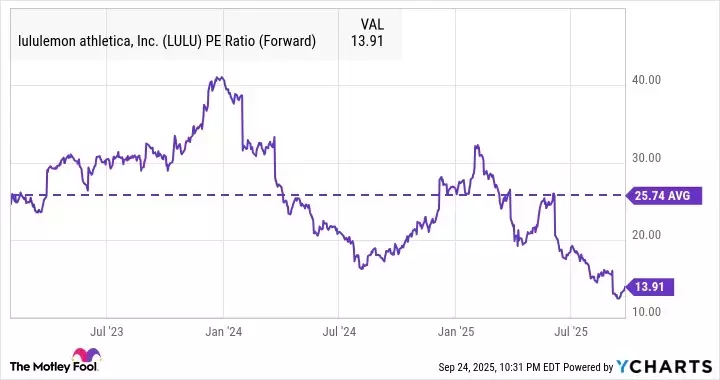
Considering Lululemon's updated EPS guidance, the stock is currently trading at a forward price-to-earnings (P/E) ratio of 14, which is approximately half the average P/E of the S&P 500. This valuation implies that the market is largely discounting the company's future growth potential, almost treating it as a no-growth enterprise. However, if Lululemon can successfully navigate its current challenges and revert to its previous trajectory of innovation and market leadership, there is significant upside potential for the stock. Historically, Lululemon has commanded a much higher valuation, often trading at twice its current P/E in recent years. While a full recovery may take time, the current depressed stock price, combined with the company's strategic responses and strong international growth, suggests that it could be an attractive investment for long-term investors.
