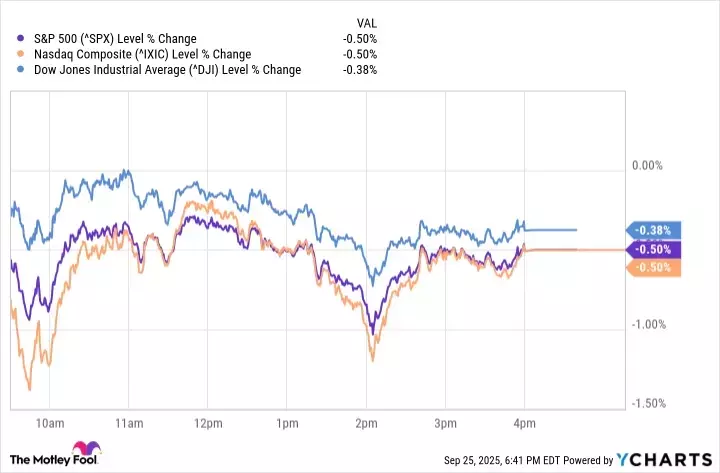
Global markets faced a challenging Thursday, with major indices closing lower for the third straight session. Investors grappled with conflicting economic signals: a resilient economy reflected in revised GDP figures versus a softening labor market. All eyes are now on Friday's inflation report, a key determinant for future monetary policy decisions. Corporate news saw Intel and IBM posting gains, while CarMax experienced a significant drop following disappointing earnings.
Market Indexes Decline Amid Anticipation of Key Inflation Data
On Thursday, September 25, 2025, Wall Street witnessed a downward drift across its major indices as market participants assessed a mixed economic landscape and braced for a critical inflation announcement. The S&P 500, a broad market benchmark, decreased by 0.5% to settle at 6,604.72 points. Similarly, the technology-heavy Nasdaq Composite saw a 0.5% reduction, closing at 22,384.70. The Dow Jones Industrial Average, comprising 30 prominent U.S. companies, also registered a decline of 0.4%, finishing the day at 45,947.32. This marked the third consecutive day of losses for these indices, as yields remained near recent peaks and traders exhibited caution, refraining from taking on additional risks ahead of the forthcoming economic data.
The market's immediate focus has now shifted to Friday's release of the Personal Consumption Expenditures (PCE) price index, a metric highly favored by the Federal Reserve for gauging inflation. This report is expected to offer crucial insights into the economy's inflationary pressures and will influence the Federal Reserve's stance on potential interest rate adjustments. Federal Reserve Chair Jerome Powell recently advocated for a patient approach to rate cuts, underscoring the significance of upcoming economic indicators.
Adding to the nuanced economic narrative were recent labor market figures. While jobless claims for the past week showed a decrease, the overall pace of hiring remained subdued, suggesting a potential moderation in the labor market's momentum. Conversely, the second-quarter Gross Domestic Product (GDP) received an upward revision, highlighting the underlying strength and resilience of economic growth even amidst prevailing tighter financial conditions.
In corporate developments, Intel experienced an 8.9% rise in its stock value, driven by market rumors of prospective investment discussions with Apple. IBM shares climbed by 5.2% following positive outcomes from a quantum computing collaboration with HSBC. In contrast, CarMax suffered a significant setback, with its stock plummeting by 20% after the company reported lower-than-anticipated earnings and issued a cautious outlook on softening sales trends.
This period of market uncertainty underscores the delicate balance investors must strike between positive economic indicators and potential inflationary pressures. The cautious sentiment prevalent on Wall Street suggests a heightened sensitivity to macroeconomic data, particularly inflation, which remains a pivotal factor in shaping future market directions and monetary policy decisions.
