
This report delves into the ambitious forecast by Beth Kindig of the I/O Fund, who projects Nvidia's market capitalization to reach an astounding $6 trillion by the conclusion of the next calendar year. This significant growth is anticipated to be fueled by robust infrastructure investments from AI hyperscalers and the progressive commercialization of Nvidia's advanced GPU architectures. The analysis explores the factors underpinning this optimistic outlook, highlighting Nvidia's pivotal role in the expanding AI landscape.
Nvidia's Ascent: Driving Forces Behind a Potential $6 Trillion Valuation
In a recent dialogue with Bloomberg, Beth Kindig, the Chief Executive Officer of the I/O Fund, a prominent technology research entity, articulated a compelling vision for semiconductor giant Nvidia. Kindig's prediction posits that Nvidia could attain a $6 trillion market valuation by the end of the upcoming calendar year, representing an approximate 43% surge from its current standing. This audacious projection mirrors the steadfast confidence displayed by figures like Cathie Wood in companies such as Tesla.
The bedrock of Nvidia's revenue generation lies predominantly within its data center segment. For the second fiscal quarter, concluding on July 27, Nvidia recorded a robust $41.1 billion in data center sales, marking a 56% year-over-year increase and translating to an annualized run rate of approximately $160 billion. Kindig's assessment suggests a high likelihood of Nvidia's quarterly data center revenue reaching $50 billion by year-end, pushing its annual run rate to $200 billion, given the nascent phase of scaling its innovative Blackwell and Blackwell Ultra GPU architectures.
Kindig further contends that market analysts might be underestimating the trajectory of capital expenditure (capex) among AI hyperscalers, particularly regarding the sheer magnitude of demand for Nvidia's Graphics Processing Units (GPUs). Her calculations indicate that a surge in infrastructure investments could propel Nvidia's data center operations to $75 billion in quarterly sales, equating to a $300 billion annual run rate, by the close of the next year. This projection implies a substantial 50% growth over her estimated 2025 year-end figures.
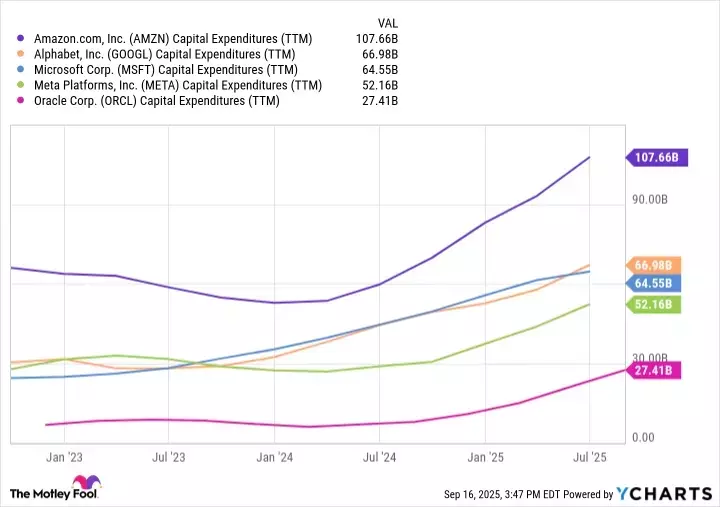
A critical underpinning for Nvidia's data center expansion is the escalating capex spending by hyperscalers, including industry titans such as Amazon, Microsoft, and Alphabet. These corporations are dedicating unprecedented financial resources to enhance computational power, thereby laying the groundwork for the subsequent evolution of the artificial intelligence era. As AI workloads intensify and novel applications emerge, the necessity for increasingly sophisticated infrastructure for both training and inference tasks becomes paramount. Nvidia, with its GPUs forming the core of these AI services, stands as the primary beneficiary of these investments.
The advancements in robotics, exemplified by companies like Amazon and Tesla investing in systems capable of intricate warehouse operations, underscore the burgeoning demand for massive GPU clusters—precisely the kind of systems Nvidia provides. Similarly, the progression of autonomous systems across various sectors—transportation, manufacturing, and defense—from conceptual stages to commercial deployment, will lead to an exponential escalation in computational demand. Nvidia's Blackwell architecture and its future iterations are specifically engineered to address this demand, offering a blend of efficiency and processing prowess that positions the company as an indispensable provider for enterprises developing critical workflows.
Concurrently, the cloud infrastructure landscape is experiencing a significant metamorphosis. The rise of GPU-as-a-service models, where companies lease access to GPU capacity from providers like Oracle and CoreWeave, creates a synergistic effect for Nvidia. This model extends Nvidia's influence beyond direct sales to hyperscalers, as it also collaborates with specialized cloud operators who subsequently lease its hardware. As businesses increasingly adopt diversified multi-platform cloud strategies, distributing workloads across numerous providers, Nvidia's presence within the rapidly evolving AI hardware ecosystem is further amplified.
The journey towards a $6 trillion valuation for Nvidia is not merely about numerical targets but reflects a profound shift in the technological landscape. The company's expanding data center business is not merely a coincidental outcome of hyperscaler investments; rather, it is a direct consequence of fundamental structural changes driving the next wave of AI applications. This underscores Nvidia's enduring position as a dominant force in AI infrastructure, suggesting considerable potential for long-term growth and a compelling investment opportunity.
Reflections on Nvidia's Trajectory in the AI Era
The ambitious forecast for Nvidia's market capitalization highlights the transformative power of artificial intelligence and the critical role of underlying hardware infrastructure. It underscores that in the rapidly evolving tech world, companies that enable innovation, rather than just consume it, are positioned for exponential growth. This report serves as a powerful reminder for investors and industry observers alike: understanding the foundational shifts in technology, such as the increasing demand for AI compute, is key to identifying future market leaders. Nvidia's success story illustrates that innovation, strategic partnerships, and a deep understanding of market needs are indispensable for sustaining dominance in a competitive landscape.
