Nvidia, a company that has transformed from a specialized graphics chip designer for gaming into a dominant force in the artificial intelligence (AI) revolution, has recently solidified its leadership with a major strategic move. The company has pledged up to $100 billion in infrastructure support for OpenAI, the developer behind ChatGPT, as the latter endeavors to advance next-generation AI applications. This substantial commitment not only reinforces Nvidia's pivotal role in the computing sector but also positions it for remarkable growth, potentially driving its market valuation towards an extraordinary $10 trillion.
Nvidia's journey from a niche graphics card manufacturer to a global AI powerhouse is remarkable. Initially known for its GPUs in the video game industry, the company adeptly pivoted to harness the computational power of its chips for AI, becoming an indispensable supplier for generative AI applications worldwide. This strategic evolution has seen Nvidia's market capitalization soar, making it one of the world's most valuable companies. Its stock performance is now a key indicator for the entire computing sector, reflecting the profound impact of its technology on various industries.
The partnership with OpenAI is a testament to Nvidia's unwavering commitment to AI innovation. On September 22, Nvidia announced its intention to provide 10 gigawatts of computing infrastructure to OpenAI. This infrastructure is crucial for powering OpenAI's advanced models and its quest for 'superintelligence,' which requires massive GPU clusters for training and scaling large language models. Nvidia's comprehensive suite of hardware and software solutions makes it the ideal partner for such an ambitious undertaking, effectively providing the backbone for OpenAI's future breakthroughs.
This collaboration also strategically strengthens Nvidia's competitive stance. Despite increasing competition from rivals like Advanced Micro Devices (AMD) and major tech companies such as Microsoft, Alphabet, Amazon, and Meta Platforms, which are developing their custom AI accelerator chips, the OpenAI deal highlights Nvidia's enduring dominance. By embedding itself deeply within OpenAI's ecosystem, Nvidia ensures long-term demand for its products, enhances its revenue visibility, and creates a powerful ecosystem lock-in, making its platform the default choice for advanced AI development.
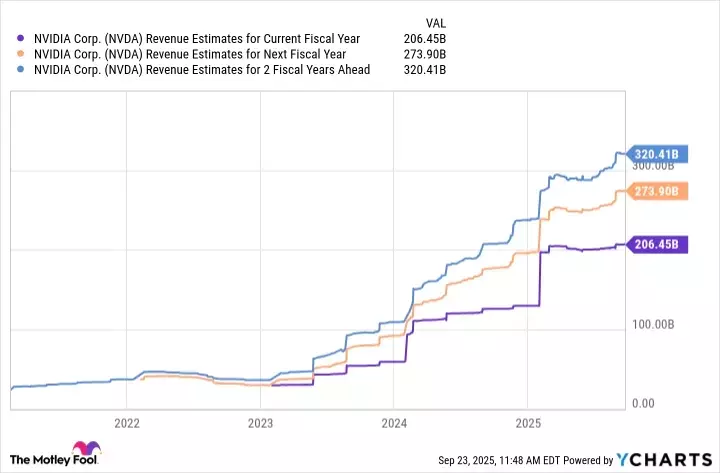
The potential financial implications of this deal are vast. While OpenAI's exact valuation is challenging to ascertain as a private entity, projections suggest its annual recurring revenue could reach $20 billion by December and potentially $125 billion by 2029. Such ambitious growth necessitates an exponential increase in processing power, making the alliance with Nvidia a logical and critical step. Current Wall Street estimates project Nvidia to generate $320 billion in annual revenues by 2027, a figure that now appears conservative in light of the OpenAI and recent Intel deals.
If Nvidia captures even 30% of OpenAI's projected annual recurring revenue, it could add nearly $40 billion to its yearly revenue. Beyond the direct financial gains, the partnership serves as a powerful endorsement from one of the most influential entities in the AI landscape. OpenAI's decision to entrust its next-generation systems to Nvidia's architecture sends a clear signal to the market: Nvidia remains the gold standard for advanced computing. This 'halo effect' is expected to resonate across various sectors, including enterprises, cloud providers, and government agencies, further solidifying Nvidia's platform as the preferred choice for AI infrastructure. This could propel Nvidia's revenues well beyond current analyst consensus, potentially reaching $500 billion by 2030. Applying its historical price-to-sales ratio, this could translate into a market capitalization exceeding $10 trillion.
Ultimately, the specific timelines and financial figures are secondary to the broader implication of these developments. Nvidia's stock continues to represent a robust, profitable, and long-term investment opportunity for those looking to capitalize on the transformative power of the AI megatrend. The company's strategic partnerships and technological prowess underscore its enduring leadership and potential for sustained growth in the rapidly evolving world of artificial intelligence.
