
In the dynamic realm of artificial intelligence investment, two distinct entities, Nvidia and Palantir, offer contrasting approaches to capitalize on the burgeoning AI trend. While Palantir's software-centric business model is characterized by its long-term stability and recurring revenue, Nvidia, a hardware powerhouse, currently exhibits superior growth rates. However, a crucial factor in discerning the better investment lies in their respective valuations, with Nvidia appearing significantly more attractively priced compared to Palantir.
Ultimately, the choice between these two AI leaders hinges on an investor's priorities. For those prioritizing sustainable revenue streams and a sticky customer base, Palantir's subscription-based software offers a compelling narrative. Conversely, investors seeking rapid expansion and a more favorable entry point in terms of stock valuation might find Nvidia to be the more appealing option, despite the potential cyclicality inherent in hardware sales.
Evaluating the Business Models: Sustainability and Growth Dynamics
The artificial intelligence landscape presents diverse investment avenues, with Nvidia focusing on hardware and Palantir specializing in AI software. Nvidia's core business revolves around manufacturing graphics processing units (GPUs), which are indispensable for AI workloads. The company anticipates a substantial increase in data center capital expenditures, projecting an rise from $600 billion this year to $3-4 trillion by 2030, a trend from which Nvidia stands to gain significantly. However, Nvidia's position isn't entirely secure, as the development of in-house AI chips by hyperscalers could erode its market share. A potential decline in demand for computing equipment also poses a risk to its revenue streams.
In contrast, Palantir's business model, centered on AI software subscriptions, offers a more enduring revenue profile. Palantir's software transforms raw data into actionable insights, empowering decision-makers and enabling the deployment of autonomous AI agents. Serving both commercial and government clients, Palantir cultivates a loyal customer base, as transitioning away from its deeply integrated software is challenging once deployed. This stickiness ensures a continuous revenue flow even after the initial AI spending boom subsides, granting Palantir a distinct advantage in business sustainability.
Growth Trajectories and Valuation Discrepancies
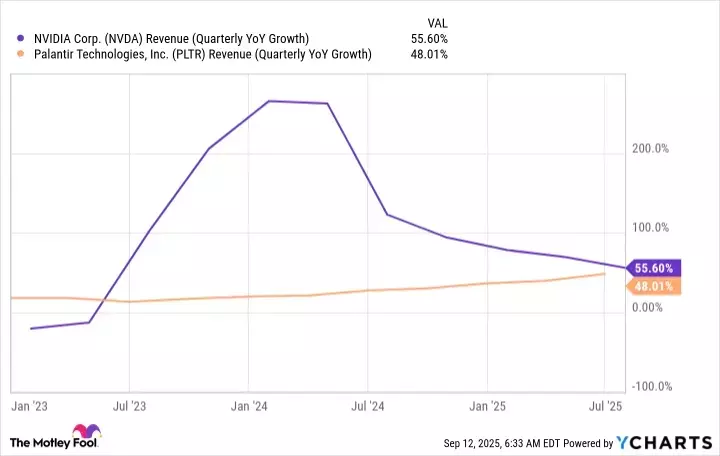
While Palantir's revenue growth is on an upward trend, Nvidia currently surpasses it in terms of expansion speed. This growth differential might shift in the future, but for the present, Nvidia maintains a lead. A potential catalyst for Nvidia's accelerated growth is the re-establishment of its operations in China, contingent on securing export licenses for its H20 chips. A successful re-entry into the Chinese market, a region with substantial AI computing demands, could significantly boost Nvidia's sales. Even without this, Nvidia's current growth rate outpaces Palantir's, positioning it favorably in terms of market expansion.
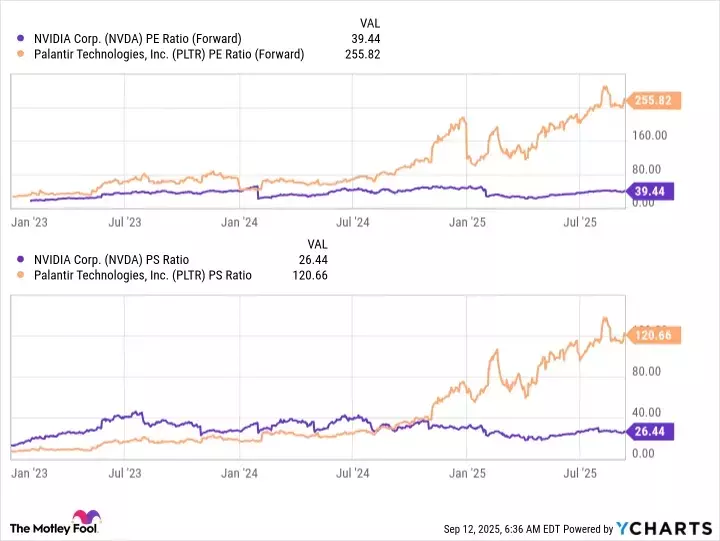
Despite comparable growth rates, a significant disparity exists in the valuations of the two companies. Palantir's stock appears considerably more expensive than Nvidia's when assessed using metrics such as forward price-to-earnings (P/E) and price-to-sales (P/S) ratios. Palantir's P/S ratio is approximately five times higher than Nvidia's, and its forward P/E ratio is about 6.5 times greater. This substantial premium for Palantir's stock seems incongruous given the similar growth rates. It would necessitate many years, potentially a decade, of sustained growth for Palantir to align its valuation with more reasonable levels, whereas Nvidia already trades at that price point. This stark valuation contrast strongly suggests that Nvidia offers a more advantageous investment opportunity currently, primarily due to Palantir's inflated stock price.
