
Opendoor Technologies, a prominent online real estate platform, is embarking on a new strategic direction with the appointment of Kaz Nejatian, formerly Chief Operating Officer at Shopify, as its new Chief Executive. This leadership change comes at a pivotal moment, following a remarkable surge in the company's stock, which climbed approximately 500% year-to-date after a period of significant decline. The company is now focused on achieving financial sustainability by implementing stringent cost reductions and exploring new avenues for service expansion, including title services and mortgage offerings. However, its current market capitalization of $7 billion, coupled with a history of unprofitability, presents a complex picture for potential investors.
The journey of Opendoor, since its public debut in 2020 through a SPAC merger, has been marked by extreme volatility. After experiencing a downturn of over 95% from its peak, the stock became a focal point for both large institutional investors and individual traders, leading to its recent impressive recovery. Despite this resurgence, the share price, at $9.50 as of September 15, remains below its initial listing value.
The decision to bring in a new leader was prompted by the board's desire for a significant turnaround strategy. Kaz Nejatian, with his proven track record at Shopify in developing successful technology businesses, is expected to inject fresh perspectives and innovative approaches. His immediate plans include shifting away from a remote-work model to foster greater innovation and collaboration within the company, drawing parallels from his successful tenure at Shopify.
In addition to Nejatian's appointment, co-founders Keith Rabois and Eric Wu are rejoining the board of directors, signaling a renewed emphasis on the company's foundational vision. Rabois has publicly indicated that a core aspect of the turnaround will involve reducing operational inefficiencies and streamlining the workforce, which he believes have hindered the company's ability to innovate. These changes are anticipated to unfold over the coming months.
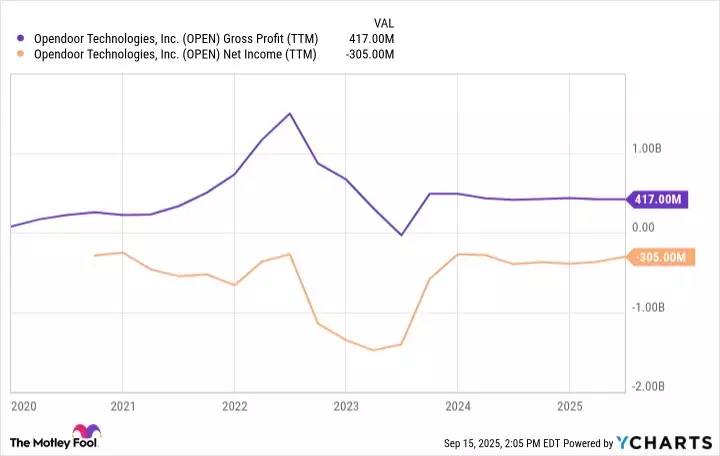
The primary challenge for Opendoor remains its path to profitability. The company’s business model, centered on buying and selling residential real estate, inherently operates on thin gross profit margins. In the last quarter, Opendoor reported revenues of $1.6 billion, but its gross profit stood at a modest $128 million, representing an 8.2% margin. After accounting for marketing, overhead, product development, and substantial interest expenses, the company posted a $29 million loss before taxes. Historically, Opendoor has yet to achieve positive net income over any 12-month period.
For the foreseeable future, Opendoor's strategy will concentrate on aggressive cost management to move towards profitability. Longer-term plans involve diversifying beyond its capital-intensive home-buying operations by introducing services such as title processing, mortgage solutions, and collaborations with real estate agents. The overarching goal is to enhance the home transaction experience for both buyers and sellers, though the precise execution strategy is still under development. Investors will closely monitor the company's ability to not only increase its gross profit but also effectively convert these gains into sustainable net income, which will be the true indicator of its long-term success.
The current $7 billion market capitalization of Opendoor reflects high expectations for its future profit growth, especially considering its recent stock performance. However, valuing an unprofitable company like Opendoor using traditional metrics such as the price-to-earnings ratio is challenging. When evaluated against its trailing 12-month gross profit of $417 million, the company's price-to-gross-profit ratio approaches 20. This valuation is notably high, even for a rapidly expanding enterprise, and particularly for a company undergoing a significant restructuring. While the new CEO and strategic initiatives suggest a potential for improvement, the combination of an ambitious valuation and a history of financial underperformance suggests that investors should approach Opendoor stock with considerable caution at this time.
