
Opendoor Technologies, a real estate company leveraging the iBuying model, recently saw its stock rebound dramatically after a period of significant decline. This resurgence is largely attributed to a major leadership restructuring, including the appointment of a new CEO with a strong background in e-commerce and the reintegration of the company's co-founders onto its board of directors. The central challenge for the reinvigorated leadership is to navigate the inherent difficulties of the iBuying business model and steer the company towards sustained profitability, a goal that has remained elusive since its public listing.
In late June, investors in Opendoor Technologies (OPEN) witnessed their shares plummet by an alarming 99% from their peak in 2021, transforming the company into what many considered a struggling penny stock. The outlook appeared bleak, with fears of ultimate failure looming large. However, in a remarkable turn of events, the company's stock value soared approximately 17-fold from its lowest point within just three months, achieving an impressive 467% year-to-date gain.
This renewed investor confidence received a substantial boost on September 10 with the announcement of Kaz Nejatian as the new Chief Executive Officer. Nejatian, formerly the Chief Operating Officer of the prominent e-commerce software giant Shopify, brings a wealth of experience to Opendoor. Concurrently, the company also revealed significant changes to its board of directors, with co-founders Keith Rabois and Eric Wu rejoining alongside Nejatian. These strategic appointments signal a comprehensive overhaul of Opendoor's management team, prompting speculation about whether this new leadership can sustain the company's unexpected comeback.
Opendoor's core business revolves around iBuying, a process where it purchases homes directly from sellers for cash, undertakes necessary renovations, and then resells them. This model necessitates efficient deal-making and rapid turnover to generate profits. While Opendoor offers supplementary services such as facilitating agent-assisted sales, an online marketplace, and title and escrow services, the vast majority of its revenue is derived from the direct sale of properties it acquires. The profitability of this model is significantly influenced by market conditions: a hot housing market makes it difficult to secure properties at favorable prices, while a cooling market, though offering better acquisition opportunities, can lead to extended holding periods and increased carrying costs, thereby eroding profit margins.
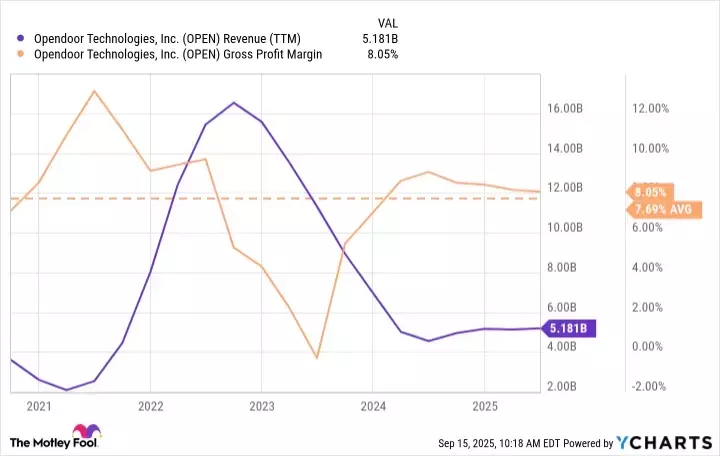
Historical data indicates that Opendoor's gross profit margin has averaged only 8% since its public debut, leaving minimal room to cover substantial operating expenses. Consequently, the company has consistently reported negative operating income on a trailing-12-month basis since its initial public offering. The newly installed leadership, spearheaded by chairman Keith Rabois, acknowledges the urgency for change. Rabois has controversially suggested that a significant portion of the company's workforce may be redundant, advocating for a drastic reduction in employees to streamline operations. He contends that the primary impediment to profitability lies not in the iBuying business model itself, but in excessive general and administrative (G&A) expenses, which encompass corporate overhead. Nejatian's past success at Shopify in optimizing G&A expenses as a percentage of revenue is seen as a key asset in addressing this issue at Opendoor. Furthermore, both Rabois and Wu emphasize the critical need for product innovation, a domain where Nejatian's expertise from Shopify is expected to revitalize Opendoor after what they perceive as several years of stagnation.
While cost reduction is undeniably beneficial for companies struggling with profitability, a closer examination of Opendoor's financials reveals that G&A expenses constituted less than 4% of its revenue in 2024 and under 3% in the first half of 2025, figures that are, surprisingly, lower than those of Shopify. This suggests that even a complete elimination of G&A expenses would not be sufficient to achieve positive operating income, underscoring that improving gross margin is the true determinant of profitability. The iBuying business model presents inherent challenges, and achieving substantial gross margin improvement is a formidable task. Given these complexities, a cautious approach is warranted, as product innovation, while promising, will require both time and significant investment to translate into tangible shareholder value. Therefore, a wait-and-see strategy seems prudent before committing to Opendoor stock.
