
The burgeoning field of artificial intelligence has propelled certain technologies and companies into the spotlight, leading to significant market interest and, at times, speculative valuations. Quantum Computing Inc. (QCi) exemplifies this phenomenon, experiencing a dramatic stock surge on the promise of quantum computing's potential in AI. However, a deeper examination reveals a disparity between market enthusiasm and the company's operational fundamentals. Unlike industry titans such as Nvidia, whose growth was underpinned by continuous innovation and strategic ecosystem development, QCi's current trajectory appears largely fueled by investor sentiment rather than robust technological leadership or financial stability. This situation underscores the critical need for investors to distinguish between genuine technological breakthroughs backed by sound business models and ventures primarily riding the wave of speculative fervor in nascent markets.
The Promise and Peril of Quantum Computing Investments: A Case Study of Quantum Computing Inc.
In a dynamic financial landscape, the intersection of advanced technology and market speculation often creates fascinating investment narratives. Nvidia, founded in the 1990s, initially specialized in graphics processing units (GPUs) for video games. However, under the visionary leadership of CEO Jensen Huang, Nvidia recognized the broader potential of GPUs in parallel processing, eventually becoming the architectural backbone for cutting-edge generative AI platforms like OpenAI's ChatGPT and Alphabet's Gemini. This foresight transformed Nvidia from a mid-tier semiconductor entity into a global leader with an unparalleled market valuation.
Today, a similar transformative potential is envisioned for quantum computing, widely considered the next major leap in AI. While still in its experimental phases, quantum computing promises to revolutionize fields from drug discovery to cryptography, potentially unlocking trillions in economic value due to its ability to solve complex problems exponentially faster than classical computers. This immense future potential has captivated investors, turning heads towards companies like Quantum Computing Inc. (QCi), a small-cap player in this emerging sector.
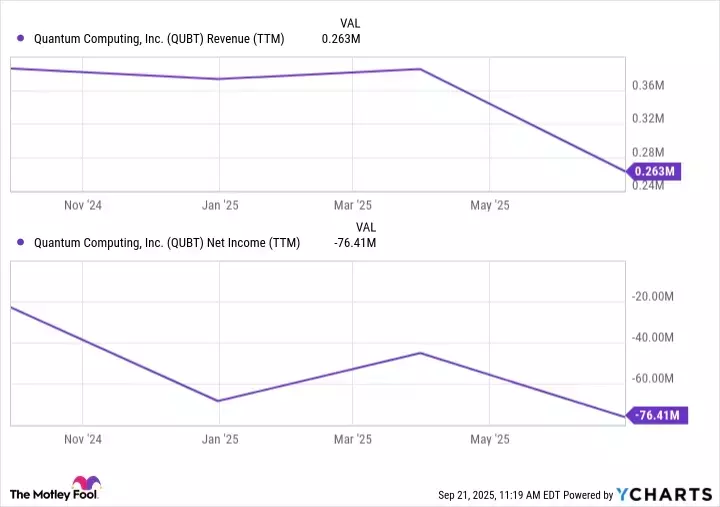
Over the past year, QCi's stock has soared by an astonishing 3,200%, a rise largely attributed to its association with a high-growth tech theme. Despite this meteoric ascent, a closer look at QCi's financials reveals minimal revenue generation and significant cash burn, casting serious doubt on its immediate path to profitability. This scenario suggests that QCi's stock performance is more a reflection of retail investor enthusiasm and a \"hype-driven narrative\" than of its inherent operational strength or technological competitive advantages.
Comparing QCi to Nvidia highlights critical differences. Nvidia established a formidable market position by not only developing innovative hardware but also by cultivating a robust software ecosystem, CUDA, which effectively locked developers into its platform. This strategic approach created a deep competitive moat. In stark contrast, QCi appears to lack such distinct advantages, showing limited traction in its business and trailing established competitors in both hardware and software development. Major tech giants like Microsoft, Alphabet, Amazon, and IBM are already making substantial investments in quantum computing, leveraging their vast resources and existing ecosystems to integrate this technology, further widening the gap between them and smaller, less established players like QCi.
Consequently, Quantum Computing Inc. has increasingly been characterized as a \"meme stock,\" attracting day traders seeking rapid profits rather than long-term investors aiming to build sustainable positions. For those interested in the quantum computing sector, a more pragmatic strategy would involve investing in diversified, profitable AI leaders that are actively exploring this nascent technology, rather than speculating on companies whose valuations may outstrip their underlying business fundamentals.
The rapid rise of Quantum Computing Inc. serves as a powerful reminder of the speculative nature often inherent in emerging technological markets. While the allure of identifying the next industry giant is strong, it's crucial for investors to conduct thorough due diligence, looking beyond catchy names and market hype. The lesson from Nvidia's journey is clear: sustainable success is built on a foundation of continuous innovation, strategic market positioning, and robust business fundamentals, not merely on the promise of a groundbreaking technology. True long-term value emerges from companies that can translate potential into tangible, competitive advantages and consistent financial performance. Therefore, aspiring investors should prioritize companies with proven track records and clear pathways to profitability when venturing into high-growth, high-risk sectors like quantum computing, rather than chasing speculative surges fueled by fleeting market sentiment.
