
Robinhood's stock has experienced an astonishing surge this year, propelled by a new collaboration with Kalshi for sports prediction markets and its addition to the S&P 500 index. This remarkable growth, however, stands in stark contrast to underlying weaknesses in its primary brokerage operations, particularly in the cryptocurrency sector. The company's current market valuation appears inflated when compared to its declining revenue trends, casting a shadow of uncertainty over its future performance and leading to concerns about a potential market correction.
Robinhood Markets, a prominent investment platform favored by younger investors, has recently embarked on a new venture into prediction markets for major sports leagues like the NFL and college football. This strategic move, announced through a partnership with Kalshi, aims to tap into the burgeoning sports betting industry. Unlike traditional sports wagering, these prediction markets allow users to engage in trading contracts based on the likelihood of specific events, with odds dynamically adjusting in response to market activity rather than fixed bookmaker adjustments. This innovative approach could position Robinhood to capture a significant share of this evolving industry, potentially worth tens of billions annually by 2030, according to Grand View Research.
Despite the excitement surrounding its new prediction market initiative and its inclusion in the S&P 500, Robinhood's core business segments are encountering notable difficulties. The company's transaction revenue, primarily derived from trading activities in stocks, options, and cryptocurrencies, reached a peak of $672 million in the fourth quarter of 2024. However, the subsequent quarters have revealed a concerning downturn, particularly in cryptocurrency trading, which saw a 55% drop to $160 million in the second quarter of 2025. This sharp decline has impacted Robinhood's overall transaction revenue, despite modest growth in other areas like options trading.
The volatility in the cryptocurrency market is a significant factor contributing to Robinhood's challenges. Many popular digital currencies, including Dogecoin, Shiba Inu, and XRP, have experienced substantial price corrections from their recent highs. This market cooling has led to reduced trading activity, directly affecting Robinhood's crypto revenue stream. This situation echoes a previous period in 2021-2022 when a massive surge in crypto revenue was followed by a dramatic 75% plunge, resulting in a severe drop of over 90% in Robinhood's stock value from its peak. This historical precedent serves as a cautionary tale for investors.
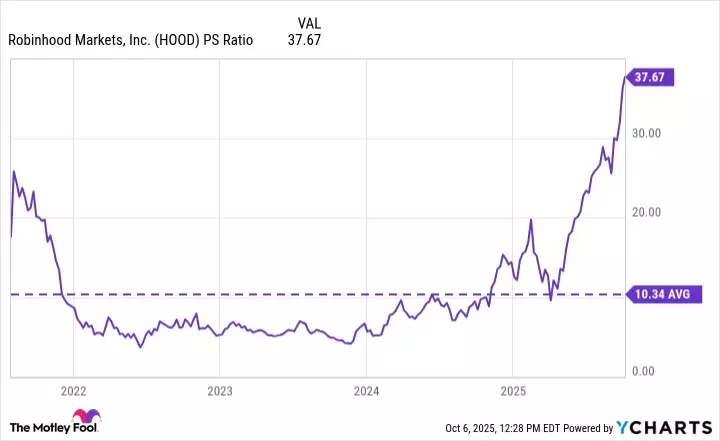
The current market valuation of Robinhood's stock raises further questions. With its price-to-sales (P/S) ratio now exceeding 37, the stock is trading at its highest level since its initial public offering in 2021. This valuation is approximately 3.6 times higher than its historical average of 10.3, indicating a potential overvaluation relative to its current business performance. For the stock to return to its long-term average valuation, it would need a substantial decline of over 70%, unless the company can achieve significant revenue growth in the near future, which appears unlikely given its performance in the first half of 2025. While the partnership with Kalshi might prove beneficial in the long run, its immediate impact on Robinhood's financial health is not expected to be substantial enough to justify the current stock price. Consequently, many analysts view Robinhood's stock as an unfavorable investment in the short to medium term, anticipating a downward trend.
