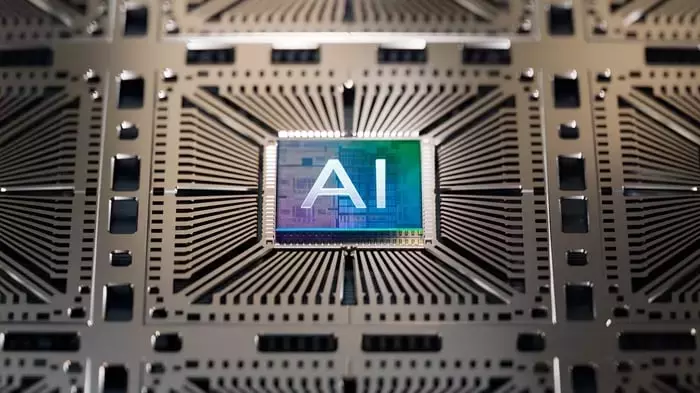
With artificial intelligence infrastructure expenditures anticipated to skyrocket fivefold in the coming years, companies beyond just Nvidia are set to reap significant benefits. This article delves into how three major semiconductor firms—Broadcom, AMD, and Taiwan Semiconductor Manufacturing (TSMC)—are strategically positioned to emerge as leaders in this burgeoning sector, offering compelling investment opportunities.
Broadcom has rapidly ascended as a pivotal force in the AI domain. As major hyperscalers, or operators of vast data centers, seek alternatives to Nvidia to mitigate costs and diversify their supply chains, many are increasingly turning to Broadcom for the development of custom application-specific integrated circuits (ASICs). These custom chips are generally more efficient and cost-effective than traditional graphics processing units (GPUs), a crucial advantage as the demand for AI inference processing intensifies.
Broadcom's expertise was first demonstrated through its collaboration with Alphabet, assisting in the design of their Tensor Processing Units, which are now integral to Google Cloud. This initial success paved the way for partnerships with other industry giants, including Meta Platforms and ByteDance. Company projections indicate that these three clients alone could generate between $60 billion and $90 billion in revenue by the fiscal year ending October 2027.
The company's momentum continues, with a fourth client, widely speculated to be OpenAI, placing a substantial $10 billion order for custom chips slated for delivery next year. The speed at which Broadcom developed these chips and prepared them for deployment has impressed industry observers. Given the multi-billion dollar agreement between OpenAI and Oracle to invest in data centers over the next five years, this presents an enormous growth opportunity for Broadcom.
While Broadcom solidifies its position in custom inference solutions, Advanced Micro Devices (AMD) is also well-prepared to benefit from the AI expansion. Developing custom AI chips requires significant upfront investment and time, making them inaccessible for all enterprises. AMD has, however, carved out a strong niche in the inference market with its GPUs, which are expected to gain traction as the market trends towards inference-focused applications.
AMD has already made considerable progress in the inference space. Its latest software platform, ROCm 7, was specifically engineered for inference workloads, and despite not matching Nvidia's CUDA in all aspects, it is largely considered effective for inference tasks. A prominent AI operator reportedly utilizes AMD's GPUs for a substantial portion of its inference traffic, and seven of the top ten AI companies now incorporate some of AMD's hardware.
Both AMD and Broadcom are also key participants in the UALink Consortium, an initiative promoting an open standard interconnect solution as an alternative to Nvidia’s proprietary NVLink. NVLink has historically provided Nvidia with a competitive edge by enabling its GPUs to function as a unified system. An open interconnect standard would allow customers greater flexibility in combining AI chips from various vendors. Considering AMD's comparatively smaller AI revenue base, the company is presented with a significant opportunity for expansion as the market increasingly shifts toward inference. Capturing even a modest share of this rapidly growing market could lead to substantial stock appreciation.
As AI infrastructure investments continue their upward trajectory in the coming years, Taiwan Semiconductor Manufacturing (TSMC) emerges as one of the most reliable and secure investment avenues. TSMC's success is assured irrespective of which chip manufacturers gain market dominance, as it serves as the foundational supplier for nearly all leading chip designers.
TSMC has established a commanding lead in advanced chip manufacturing, particularly those requiring smaller node sizes, which permit a higher density of transistors on a single chip. The company has become an indispensable partner for chip developers, especially as competitors like Intel and Samsung have encountered challenges with yield rates at these smaller nodes. This consolidates TSMC's position as the primary viable option for the dependable production of high-performance semiconductors, granting it considerable pricing power. Reports suggest TSMC plans to increase prices by 10% next year.
TSMC anticipates that AI chip demand will experience a compound annual growth rate (CAGR) exceeding 40% through 2028. The company is actively progressing towards 2nm production, a development that will further enhance chip efficiency and maintain its competitive advantage. Beyond AI, long-term drivers such as autonomous driving, robotics, and quantum computing are expected to sustain demand for advanced chips. Consequently, TSMC represents an excellent strategic investment to capitalize on the ongoing surge in AI infrastructure spending.
