
This analysis delves into the investment philosophy behind the Schwab US Dividend Equity ETF (SCHD), contrasting its approach with other income-focused exchange-traded funds. While SCHD's 3.7% dividend yield might appear modest compared to some counterparts, its rigorous stock selection methodology, which prioritizes a blend of yield, corporate strength, and growth prospects, positions it as a potentially superior long-term investment. The article underscores the importance of considering dividend growth alongside current yield, especially in mitigating the impact of inflation on investment returns. Investors are encouraged to look beyond immediate yield figures to appreciate the strategic advantages offered by SCHD's differentiated portfolio construction, which aims to deliver sustainable income and capital appreciation.
Insightful Investment: Schwab US Dividend Equity ETF's Unique Strategy
On September 16, 2025, investment expert Reuben Gregg Brewer shed light on the Schwab US Dividend Equity ETF (SCHD), presenting it as a noteworthy contender for investor portfolios, despite its dividend yield of approximately 3.7%. This figure, while substantial when compared to the broader S&P 500 index's roughly 1.2% yield, is positioned against other high-yield ETFs such as the Invesco High Yield Equity Dividend Achievers ETF (PEY), which boasts a higher yield of around 4.5%.
The central theme of Brewer's commentary is that a singular focus on dividend yield can be a pitfall for investors. He articulated that PEY's strategy primarily involves acquiring shares in the 50 highest-yielding companies that have consistently increased their dividends for at least 25 years. This approach, while generating a high yield, often leads to investments in companies facing operational challenges, thereby exposing investors to increased business risk.
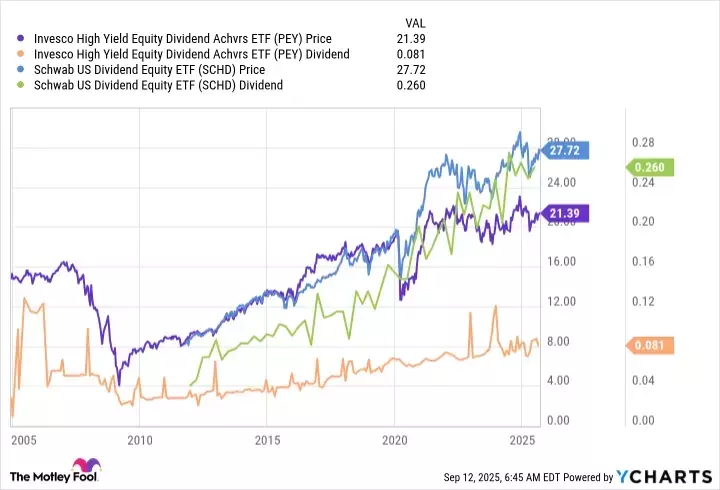
In stark contrast, SCHD employs a more intricate and selective process. It identifies companies that have a track record of increasing dividends for at least a decade, deliberately excluding real estate investment trusts (REITs). Subsequently, it evaluates these candidates using a composite score that assesses critical factors such as cash flow in relation to total debt, return on equity, current dividend yield, and the five-year dividend growth rate. The top 100 companies, weighted by market capitalization, are then included in the ETF's portfolio. This sophisticated methodology has historically resulted in SCHD demonstrating a consistent rise in both its dividend payouts and share price, a trend not as pronounced in ETFs that prioritize yield above all else.
Beyond the Immediate Yield: A Strategic Approach to Dividend Investing
This discussion profoundly emphasizes that dividend growth is a crucial, often overlooked, element in dividend investing. While a high current yield is attractive, the erosive effects of inflation can diminish the real purchasing power of static dividend payments over time. An ETF like SCHD, which actively seeks out companies with strong dividend growth potential, offers a protective hedge against inflation, potentially delivering a higher income stream in the long run than initially higher-yielding but stagnant alternatives. For investors capable of accommodating a lower initial income, or those looking to diversify their income streams, SCHD represents a thoughtfully constructed option that balances immediate returns with sustainable long-term growth and stability, moving beyond the simple allure of the highest possible yield.
